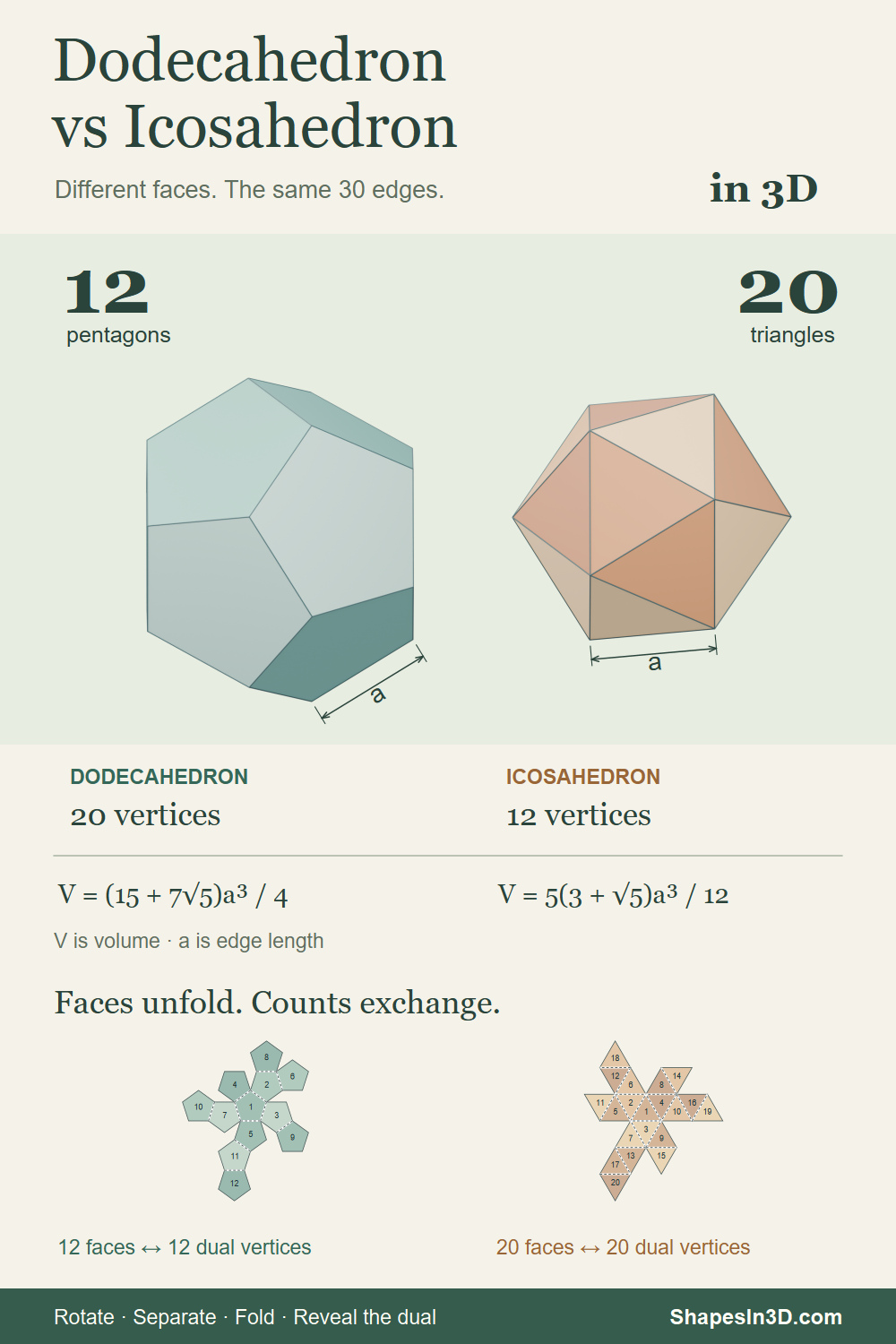
Twelve pentagons or twenty triangles? These two regular solids share thirty edges, but
exchange their numbers of faces and vertices. Explore their surfaces, unfold their nets,
and reveal the geometric connection between them.
Explore This Comparison
Dodecahedron
Regular pentagonal faces
Closed solidFlat net
AssembledSeparated
Orange points are face centers. Join centers across shared edges to form the
icosahedron inside.
12faces30edges20vertices
Icosahedron
Equilateral triangular faces
Closed solidFlat net
AssembledSeparated
Orange points are face centers. Join centers across shared edges to form the
dodecahedron inside.
20faces30edges12vertices
Drag to rotate · Scroll or pinch to zoom · Arrow keys rotate the focused model. Turn off
Link Rotations to explore one shape at a time.
Choose What Stays Equal
Equal edge length: a = 2 cm on both solids. The dodecahedron has the larger
circumradius.
Numbers stay the same.
One Shape Hiding Inside the Other
Place a point at the center of every face. Connect two points whenever their faces share
an edge. The dodecahedron produces an icosahedron, and the icosahedron produces a
dodecahedron. These are dual polyhedra.
Faces become vertices, vertices become faces, and each original edge corresponds to one
dual edge. Both solids keep the same count of thirty edges.
The orange inner solid joins actual face centers. It has its own edge length and is
smaller than the surrounding solid.
Count the Faces. Follow the Folds.
A regular dodecahedron has twelve congruent regular pentagons, with three faces meeting at
each vertex. A regular icosahedron has twenty congruent equilateral triangles, with five
faces meeting at each vertex. Each net below contains every face exactly once.
Shape properties and visible face nets
Property
Dodecahedron
Icosahedron
Faces
12 regular pentagons
20 equilateral triangles
Edges
30 equal edges
30 equal edges
Vertices
20 vertices
12 vertices
Faces meeting at a vertex
3 pentagons
5 triangles
Angle inside each face
108°
60°
Euler’s formula
20 − 30 + 12 = 2
12 − 30 + 20 = 2
A preferred base?
No. Any face can be chosen to rest on.
No. Any face can be chosen to rest on.
Flat face nets
12 regular pentagons. Dashed lines are folds.
20 equilateral triangles. Dashed lines are folds.
Dashed lines are hinges. These are two possible non-overlapping nets, not the only
arrangements. The face numbers match Net and Separate views.
Which One Has More Volume?
First choose a size comparison. For the same edge length, the
dodecahedron encloses about 3.51 times the volume and has a larger outer radius. For the
same circumradius, its volume is still larger, but only by about 9.82%.
More faces alone does not mean more volume. Use the switch above to compare both cases.
Dodecahedron
Edge a =
cm
Volumecm3
Surface areacm2
VolumeV = (15 + 7√5)a³ / 4
cm3
Surface areaS = 3√(25 + 10√5)a²
cm2
One pentagon areaA = √(25 + 10√5)a² / 4
cm2
CircumradiusR = √3(1 + √5)a / 4
cm
Total edge length30a
cm
Icosahedron
Edge a =
cm
Volumecm3
Surface areacm2
VolumeV = 5(3 + √5)a³ / 12
cm3
Surface areaS = 5√3a²
cm2
One triangle areaA = √3a² / 4
cm2
CircumradiusR = √(10 + 2√5)a / 4
cm
Total edge length30a
cm
These formulas apply to regular convex solids. Circumradius is the distance from the
center to any vertex. Values use the selected scale and are rounded to two decimal places.
Questions About These Two Solids
Why do they both have 30 edges?
Each edge belongs to two faces. The dodecahedron gives 12 × 5 ÷ 2 = 30 edges. The
icosahedron gives 20 × 3 ÷ 2 = 30 edges. Counting every face edge without dividing by
two counts each shared edge twice.
Which shape has 12 faces and 20 vertices?
The regular dodecahedron has 12 pentagonal faces and 20 vertices. The regular
icosahedron reverses those counts: 20 triangular faces and 12 vertices.
Are both shapes Platonic solids?
Yes. In each solid, every face is the same regular polygon, and the same number of
faces meet at every vertex. They are two of the five convex Platonic solids.
Is a dodecahedron a 12-sided die?
A regular dodecahedron is the usual shape of a D12 die; a regular icosahedron is the
usual shape of a D20 die. A geometric model alone does not guarantee that a
manufactured die is fair.
Does an icosahedron have a base?
It has no uniquely distinguished base. All 20 faces are equivalent under its
symmetries. You can choose a face to rest on, but that does not change the face count
or make it a prism or pyramid.
Does duality make the two solids the same size?
No. Duality describes how faces, edges, and vertices correspond. The face-center
construction produces a smaller solid inside the original. Separately, the size switch
compares the two main models with equal edge lengths or equal circumradii.
Dodecahedron vs Icosahedron in 3D
A featured comparison of complete pentagonal and triangular solids, their exchanged
counts, foldable nets, and regular-solid formulas.