
Dodecahedron in 3D
Twelve pentagons. Thirty edges. Twenty corners. Explore the regular solid, one face at a time.
On this page6 sections
A meeting of twelve pentagons
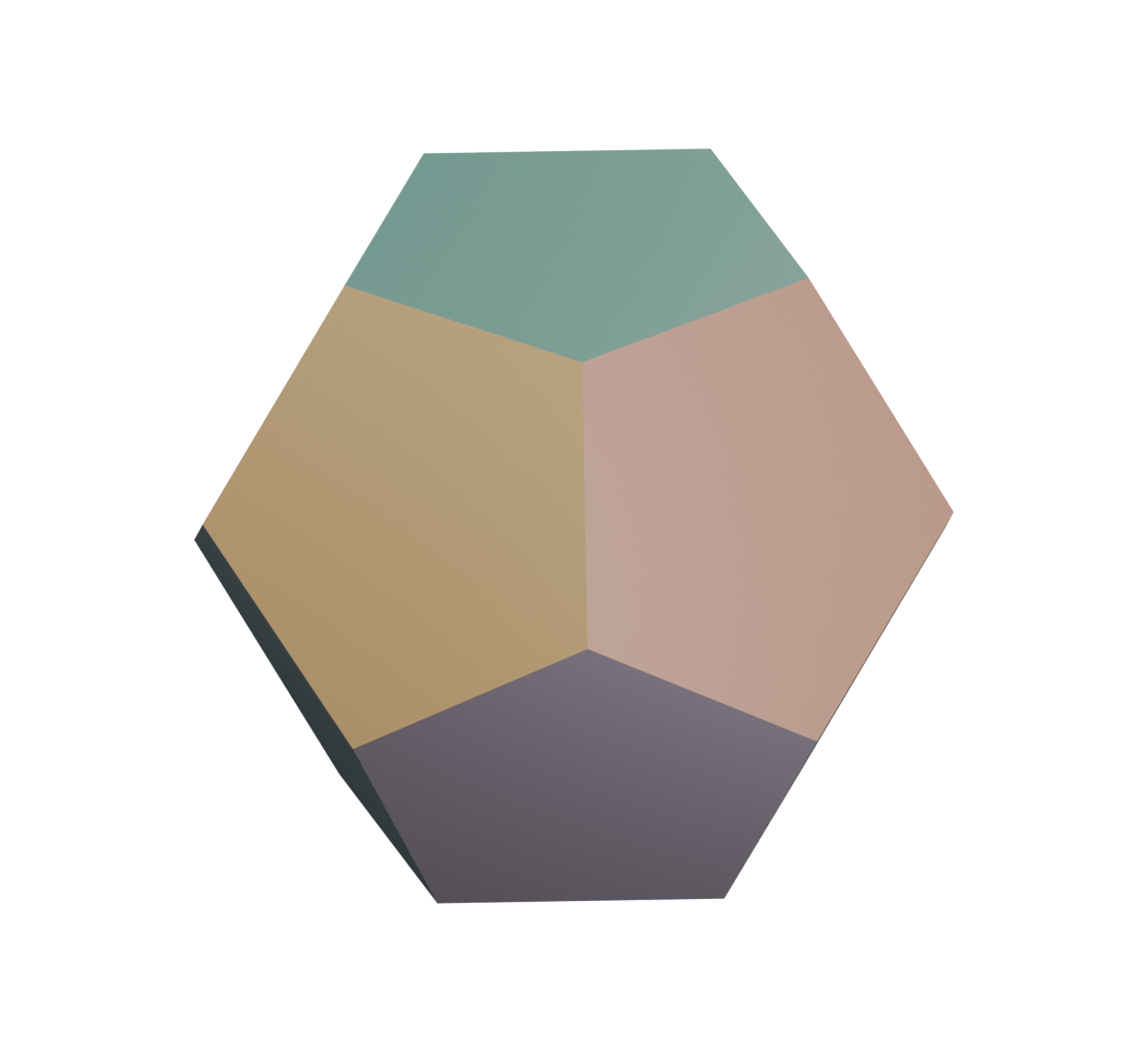 12 faces · 30 edges · 20 vertices
One edge sets the size.
Enter an edge length from 0.1 to 1,000. Results show the last valid value.
The view scales to fit. Units relabel values without converting them.
units³
The space inside the solidunits²
The area of all twelve pentagonsWhat is a dodecahedron?
A dodecahedron is any three-dimensional solid with twelve faces. This is the regular dodecahedron: twelve identical regular pentagons, with three faces meeting at every vertex.
Everything begins with a pentagon.
Five sides. Five equal angles.
Look straight at any face and you see the same regular pentagon. Each interior angle is 108°. Its diagonal is φ times the length of its side.
How many edges and vertices does a dodecahedron have?
Dodecahedron net:
twelve pentagons.
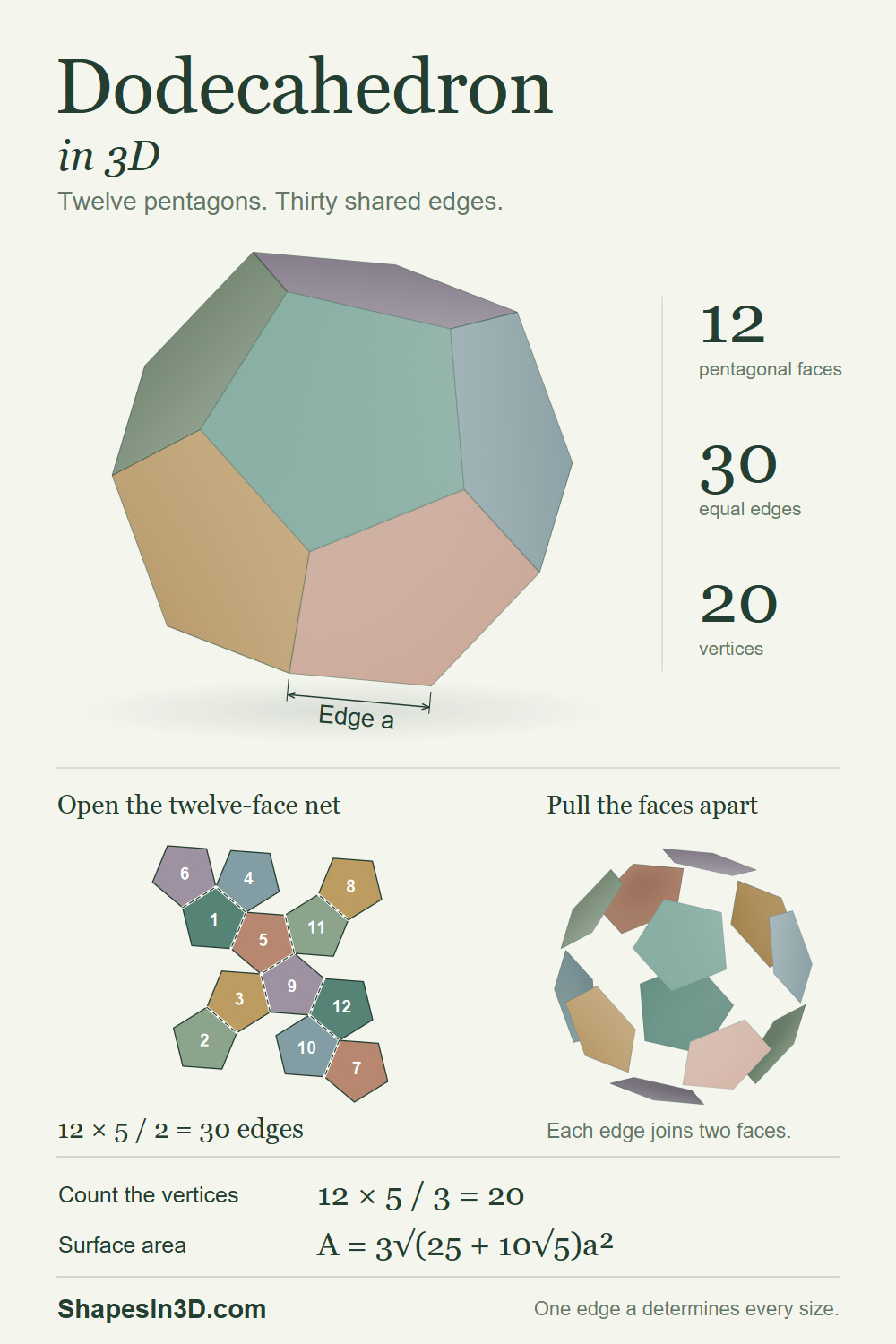
Twelve pentagons stay joined along eleven folding edges. Follow the face numbers to see where each one belongs.
The dashed lines in this net are hinges. Fold them back together to close the dodecahedron. Although the net has more exposed boundary segments, the closed solid still has 30 edges: each edge joins two of the 12 × 5 pentagon sides.

From one edge,
every measurement.
For a regular dodecahedron with
edge length a =
2 units.
Volume
Space enclosed by the solid
V = (15 + 7√5) / 4 × a³
(15 + 7√5) ÷ 4 × 2³
units³
Surface area
Area of all twelve faces
S = 3√(25 + 10√5) × a²
3√(25 + 10√5) × 2²
units²
One face
Area of a single pentagon
A = √(25 + 10√5) / 4 × a²
√(25 + 10√5) ÷ 4 × 2²
units²
Inradius
Center to the middle of a face
r = √(250 + 110√5) / 20 × a
√(250 + 110√5) ÷ 20 × 2
units
Circumradius
Center to a vertex
R = √3(1 + √5) / 4 × a
√3(1 + √5) ÷ 4 × 2
units
Total edge length
Length of all thirty edges
E = 30a
30 × 2
units
Results update with the size control and are rounded to three decimal places. These formulas apply to the regular dodecahedron.
The solid and its twelve faces.

A closer look.
- Fivefold symmetry
- Viewed straight onto a face, the regular solid has rotational symmetry through 72°, one fifth of a full turn.
- Angles between faces
- The interior dihedral angle is approximately 116.565°. The 108° angle belongs to the flat pentagonal face.
- Euler’s formula
- Vertices − edges + faces = 20 − 30 + 12 = 2.
Are all dodecahedra made of regular pentagons?
No. The name describes a solid with twelve faces. The regular dodecahedron has twelve equal regular pentagons; other dodecahedra can have different face shapes.
How is it different from a dodecagon?
A dodecagon is a flat polygon with twelve sides. A dodecahedron is a three-dimensional solid with twelve faces.
What if I double the edge length?
Surface area multiplies by four and volume multiplies by eight. There are still twelve faces, thirty edges and twenty vertices.
A small atlas of
twelve pentagons.
The regular 3D dodecahedron, opened out and brought back together.
- 12
- faces
- 30
- edges
- 20
- vertices
One edge sets the scale.
Every pentagon has the same edge length, a. The image keeps that measurement beside the solid.
Follow the faces.
The flat net and separated view show where all twelve pentagons belong.