
Ellipsoid vs Sphere in 3D
A sphere is an ellipsoid whose three semi-axes are equal. Give each direction its own radius and you get an ellipsoid; set a = b = c = r and it becomes a sphere. The models below let you compare both shape and size.
Explore This Comparison
Ellipsoid
Stretch three ways.
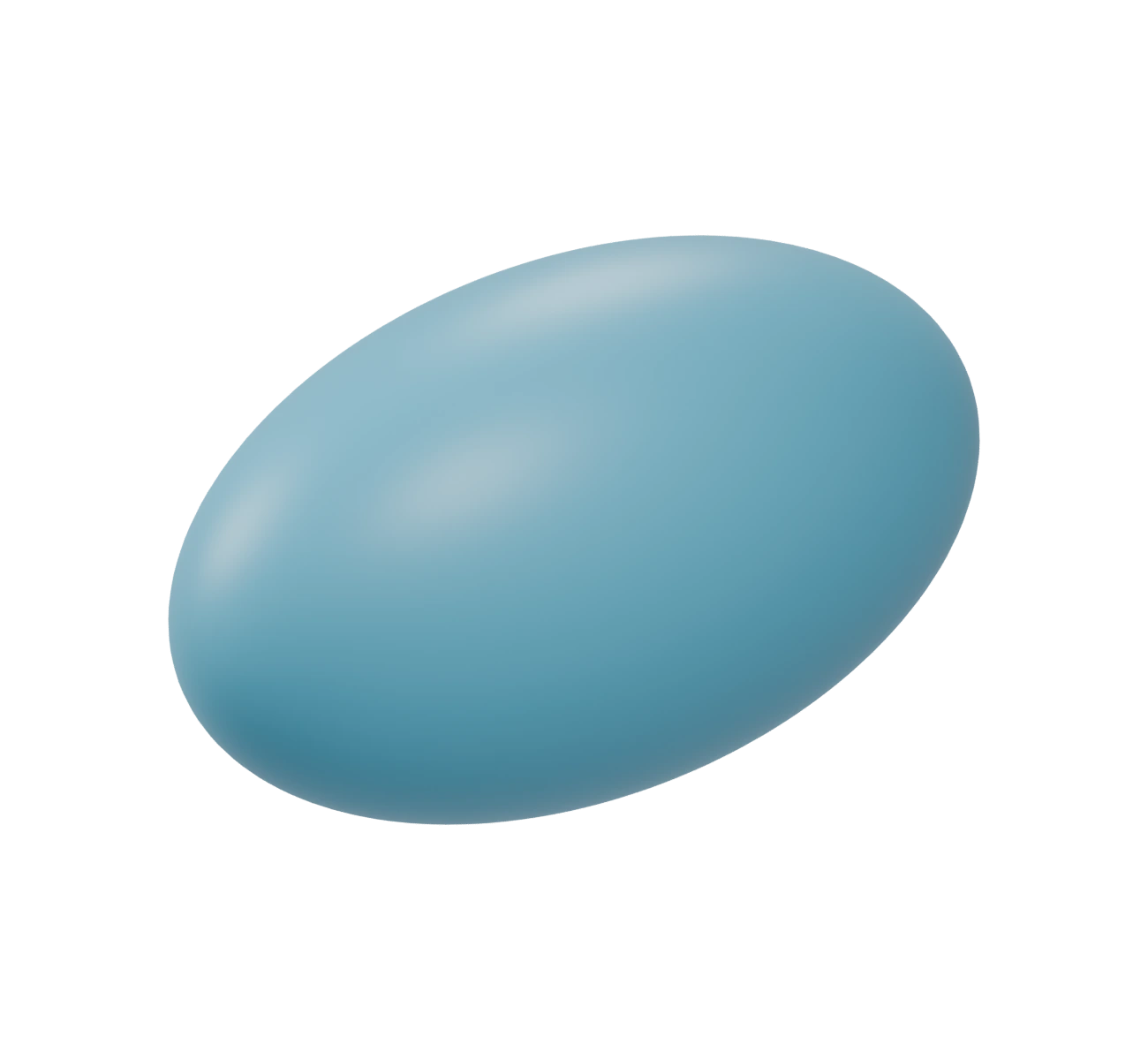
V = 4πabc / 3
Sphere
One radius in every direction.
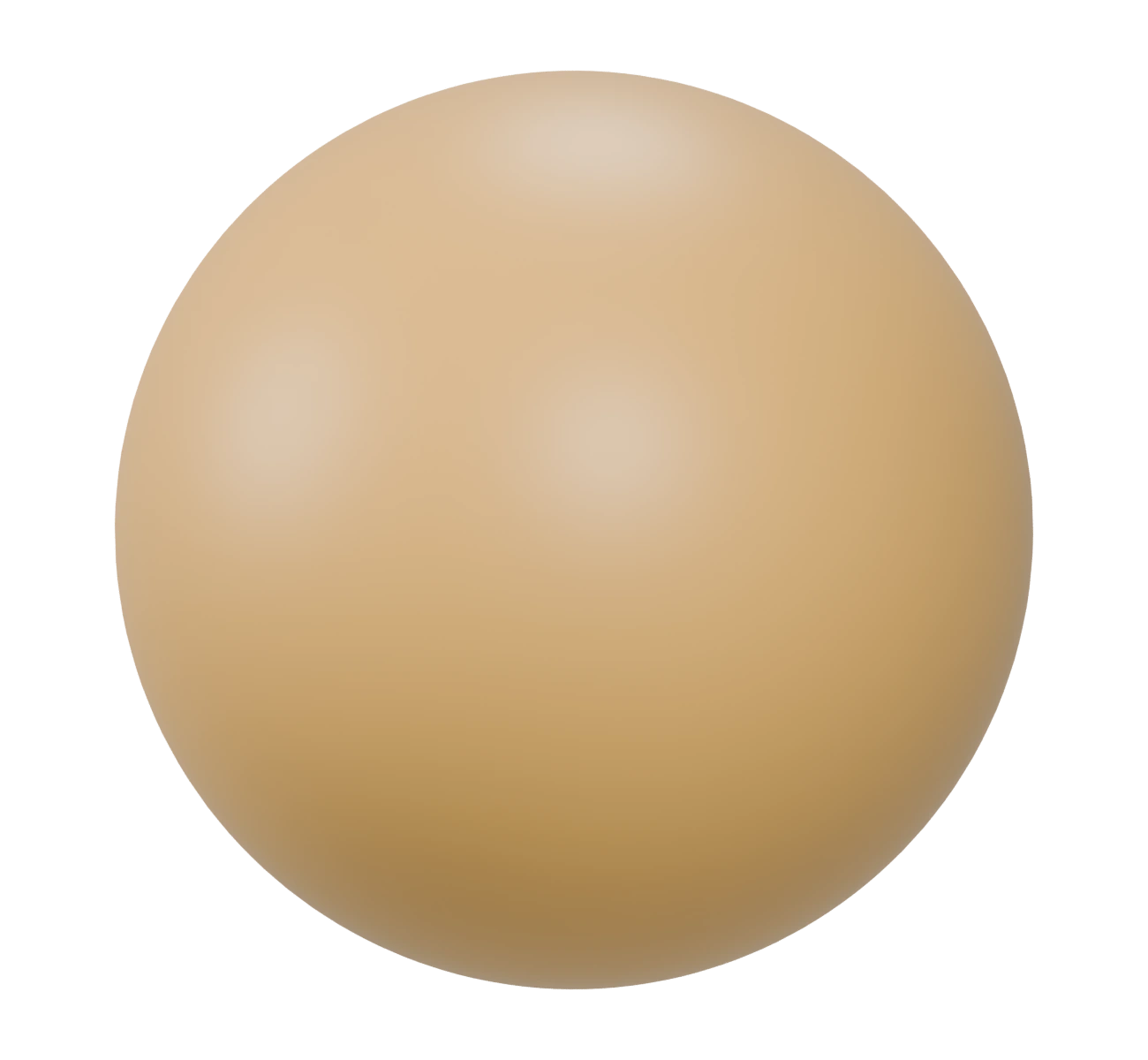
V = 4πr³ / 3
Stretch the Ellipsoid
Size the Sphere
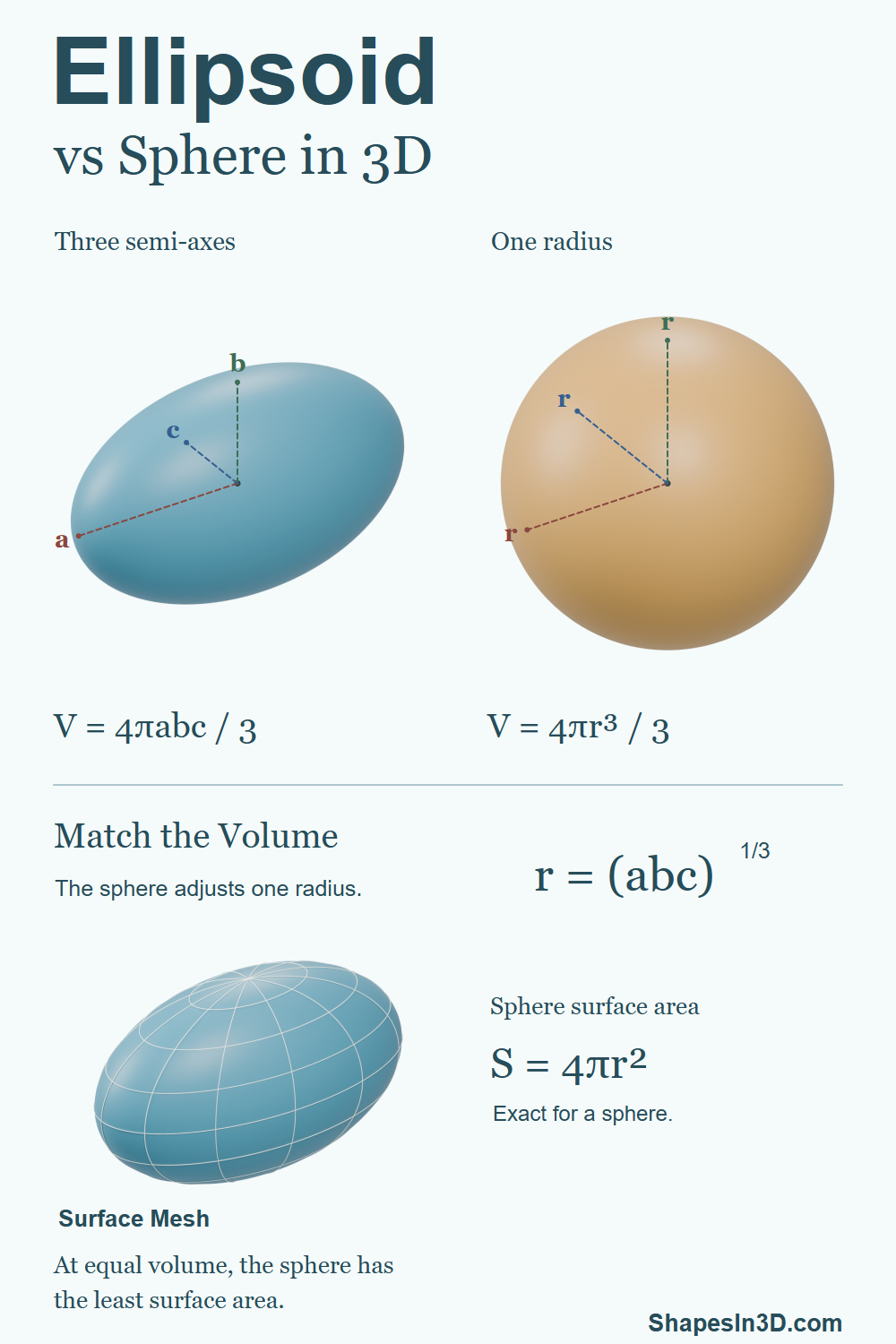
The labels a, b, and c mark the ellipsoid’s semi-axes; r marks the sphere’s radius. Each dashed measurement runs from the center to the surface, so it is half a full axis length.
Drag to rotate · Scroll or pinch to zoom · Arrow keys rotate the focused model. Switch off Link Rotations to move only one shape.
Changing units relabels the numbers.
Three independent semi-axes determine the ellipsoid. One radius determines the sphere.
Same Space.
Different Surface.
Match the volume, then change the shape. The sphere radius follows r = ∛(abc).
This makes the sphere radius automatic.
Ellipsoid / sphere volume = 0.74
Surface Area Measures a Different Thing
The sphere’s area is exactly 4πr². A general ellipsoid needs a more involved calculation; the displayed value uses the Thomsen approximation. At equal volume, the sphere has the smallest exact surface area among closed surfaces enclosing that volume.
Ellipsoid area, approximate
cm24π[((ab)ᑫ + (ac)ᑫ + (bc)ᑫ)/3]¹/ᑫ
Sphere area, exact
cm24πr²
q = 1.6075. The approximation becomes exact when a = b = c. All displayed results are rounded to two decimal places.
The Equal-Axis Equation
x²/a² + y²/b² + z²/c² = 1
For a sphere, all denominators equal r². Multiplying through gives x² + y² + z² = r².
x² / 16 + y² / 6.25 + z² / 4 = 1
Test a Point on the Ellipsoid
Substitute coordinates. A value below 1 is inside, 1 is on the surface, and above 1 is outside.
Circles, Ellipses, and a Smooth Surface
Every plane section through a sphere is a circle, a tangent point, or empty. An ellipsoid’s non-degenerate plane sections are ellipses, which can be circular in special directions. Neither has flat polygonal faces, straight edges, or polyhedral vertices.
Bottom: −1Center: 0Top: 1
Ellipsoid:
cm2Sphere:
cm2
| Property | Ellipsoid | Sphere |
|---|---|---|
| Semi-axes | Three: a, b, c | All equal: r, r, r |
| Full dimensions | cm × cm × cm | Diameter cm in every direction |
| Volume | 4πabc/3 | 4πr³/3 |
| Surface area shown | Approximate for unequal axes | Exact: 4πr² |
| Exact flat polygon net | Not possible without distortion | Not possible without distortion |
| Central horizontal section |
|
|
The mesh view follows the smooth surface. Its lines do not turn either solid into a polyhedron. The section slider uses y = ub for the ellipsoid and y = ur for the sphere.
Common Questions
Is every sphere an ellipsoid?
Yes. It is the equal-axis case a = b = c. Not every ellipsoid is a sphere.
Is an ellipsoid just a stretched sphere?
An axis-aligned ellipsoid can be produced by scaling a sphere independently along three perpendicular directions. Unequal scale factors change circles into ellipses in its principal sections.
Are a, b, and c diameters?
No. They are semi-axes measured from the center to the surface. The full axis lengths are 2a, 2b, and 2c.
Can a sphere have a printable flat net?
It cannot have an exact flat net that preserves all surface distances without stretching or cutting into approximations. Maps and paper globe patterns introduce distortion or approximate the surface with pieces.
Can equal-volume solids have different surface areas?
Yes. Matching volume does not match area. For the same enclosed volume, the sphere minimizes exact surface area. The ellipsoid area displayed here is an approximation.
One Radius or Three Semi-Axes?
Save the complete 3D forms, labeled dimensions, exact volume formulas, and a supporting surface-mesh comparison.
Pin ItView Featured Image