Oblate
p < r
Flattened at the poles

Home Ellipsoid vs spheroid
An ellipsoid can have three different perpendicular semi-axes. A spheroid is the special case with two equal semi-axes, giving rotational symmetry around the third axis. Flatten it, stretch it, or make all three equal to reach a sphere.
Three independent semi-axes.

a, b, c
Two equal equatorial radii.

r, p, r
Drag to rotate · Scroll or pinch to zoom · Arrow keys rotate the focused model. Switch off Link Rotations to move only one shape.
Prolate spheroid: the polar radius p is greater than r.
Rotate an ellipse around one of its axes and it sweeps out a spheroid. On this page, the polar axis is vertical y. The equatorial plane is xz, where the cross-section is a circle of radius r.
A fully triaxial ellipsoid has no such continuous rotational symmetry: its three principal radii are all different.
p < r
Flattened at the poles
p > r
Longer along the poles
p = r
All radii equal
x²/a² + y²/b² + z²/c² = 1
a, b, and c are center-to-surface distances, not full diameters.
(x² + z²)/r² + y²/p² = 1
The two equatorial radii share r. The independent polar radius is p.
For a general ellipsoid, the displayed approximation is 4π[((ab)q + (ac)q + (bc)q)/3]1/q, with q = 1.6075. It is exact when all three radii are equal.
For a prolate spheroid, S = 2πr²[1 + p asin(e)/(re)]. For an oblate spheroid, S = 2πr²[1 + (1 − e²)atanh(e)/e]. At p = r, the calculation uses S = 4πr² directly.
At normalized height u, where u = y/b for the ellipsoid and u = y/p for the spheroid, both sections shrink by the factor 1 − u² in area. The spheroid’s horizontal sections stay circular.
| Property | Ellipsoid | Spheroid |
|---|---|---|
| Independent radii | 3: a, b, c | 2: equatorial r and polar p |
| Rotational symmetry | Not continuous when all axes differ | Around the polar axis |
| Flat polygon faces / edges | None / none | None / none |
| An exact flat net? | No, flattening requires distortion | No, flattening requires distortion |
| Central horizontal section |
|
|
Surface Mesh shows latitude-like and longitude-like curves. These are drawing aids on a smooth surface, not straight edges or flat faces.
Yes. It is an ellipsoid with at least two equal principal semi-axes. A triaxial ellipsoid has three unequal semi-axes and is not a spheroid.
A sphere is the equal-axis limiting case, with p = r. It is also an ellipsoid. Some descriptions reserve “spheroid” for the non-spherical oblate and prolate cases; this page includes the spherical limit explicitly.
No. An ellipse is a two-dimensional curve. An ellipsoid is a three-dimensional surface with elliptical principal sections.
An oblate spheroid is a useful smooth approximation to Earth’s overall shape. It does not describe the detailed surface or all variations of the gravity field.
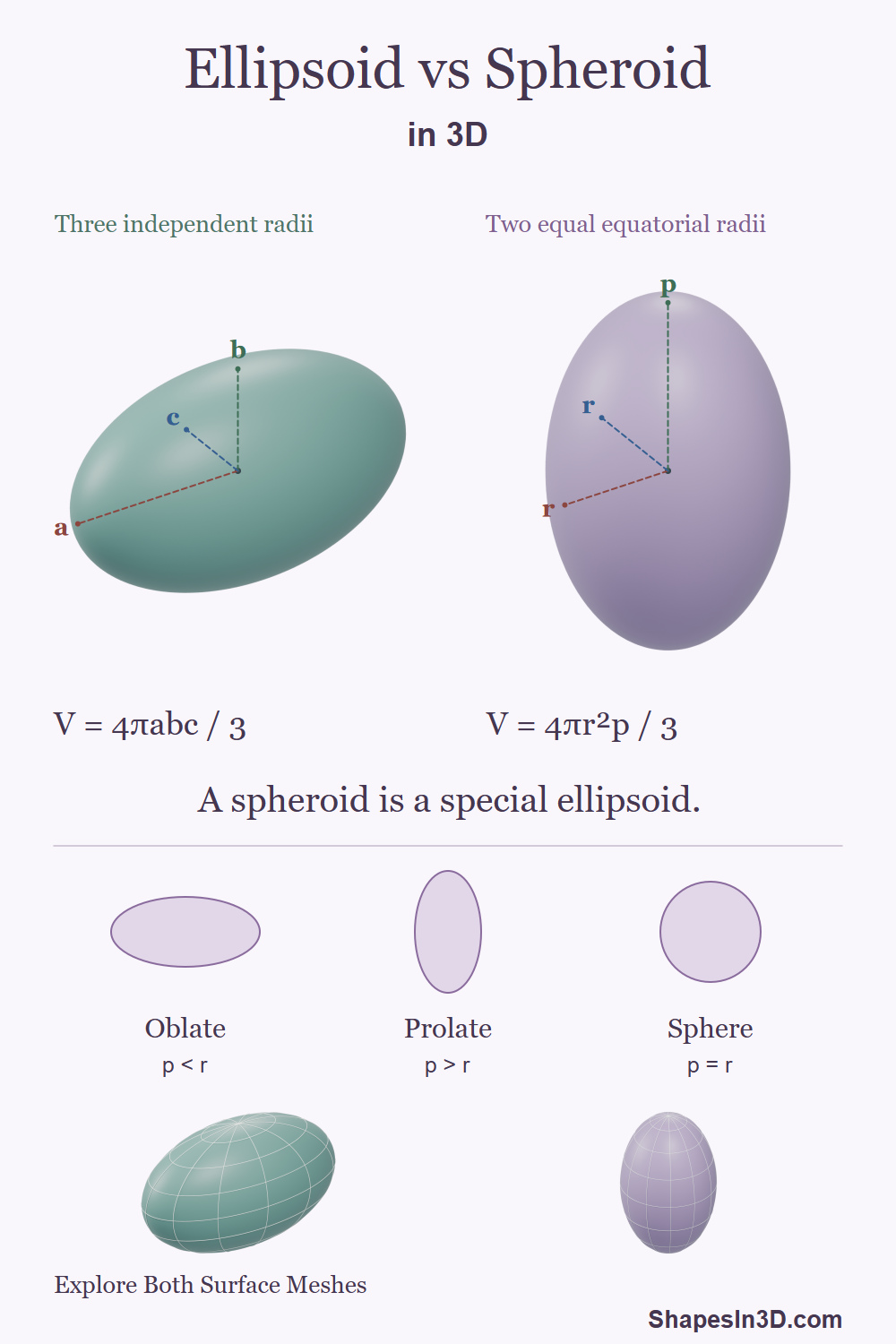
The featured image pairs complete 3D surfaces with labeled semi-axes, volume formulas, and mesh views that reveal the curved geometry.
Pin ItView Featured Image