
Ellipsoid in 3D
A sphere, stretched in three directions.
An ellipsoid is a smooth closed surface described by three perpendicular semi-axes: a, b and c. Each is a center-to-surface distance, so the full dimensions are 2a, 2b and 2c.
On this page6 sections
Units relabel dimensions without conversion.

Loading the interactive model…
Drag to rotate · Pinch or scroll to zoom
Solid view
units³
Exact: 4πabc / 3units²
An approximation; not an elementary exact formula.- Full width
- units
- Full height
- units
- Full depth
- units
Three ellipses explain the surface.


Every point follows one equation.
x²/a² + y²/b² + z²/c² = 1
Set all three semi-axes equal and the ellipsoid becomes a sphere. Set two equal and it becomes a spheroid. The surface has no straight edges or polyhedral vertices.

About the surface-area result
The displayed approximation is 4π[((ab)p + (ac)p + (bc)p)/3]1/p, with p = 1.6075. It is exact for a sphere and approximate for unequal axes. The volume calculation is exact for every valid setting.
A slice at vertical coordinate y has area πac(1 − y²/b²). The gold section in the model follows this relationship.
Use the equation with your three semi-axes.
The model uses x for width, y for height and z for depth. With the current settings, its surface satisfies:
x² / (4)² + y² / (2.5)² + z² / (2)² = 1
Inside, on the surface, or outside?
Substitute a point’s coordinates into the left-hand side. A value below 1 is inside; 1 is on the surface; above 1 is outside.
A slice has its own ellipse
At height y, the horizontal cross-section has area πac(1 − y²/b²). It is largest at y = 0 and shrinks to a point at y = ±b.
The smooth curved surface cannot be cut into an exact flat polygon net without distortion. The surface mesh is a display aid, not a set of flat faces.
Questions about the shape
Are a, b and c full diameters?
No. They are semi-axes. Double each control value to obtain the full width, height or depth.
Does an ellipsoid have faces?
It has a continuous curved surface, with no flat polygonal faces or straight edges. The mesh view is a drawing aid.
Does changing units convert the dimensions?
No. A unit change relabels the same numeric dimensions and results.
Keep the three
semi-axes in view.
The surface, its mesh and an elliptical slice share the same three dimensions.
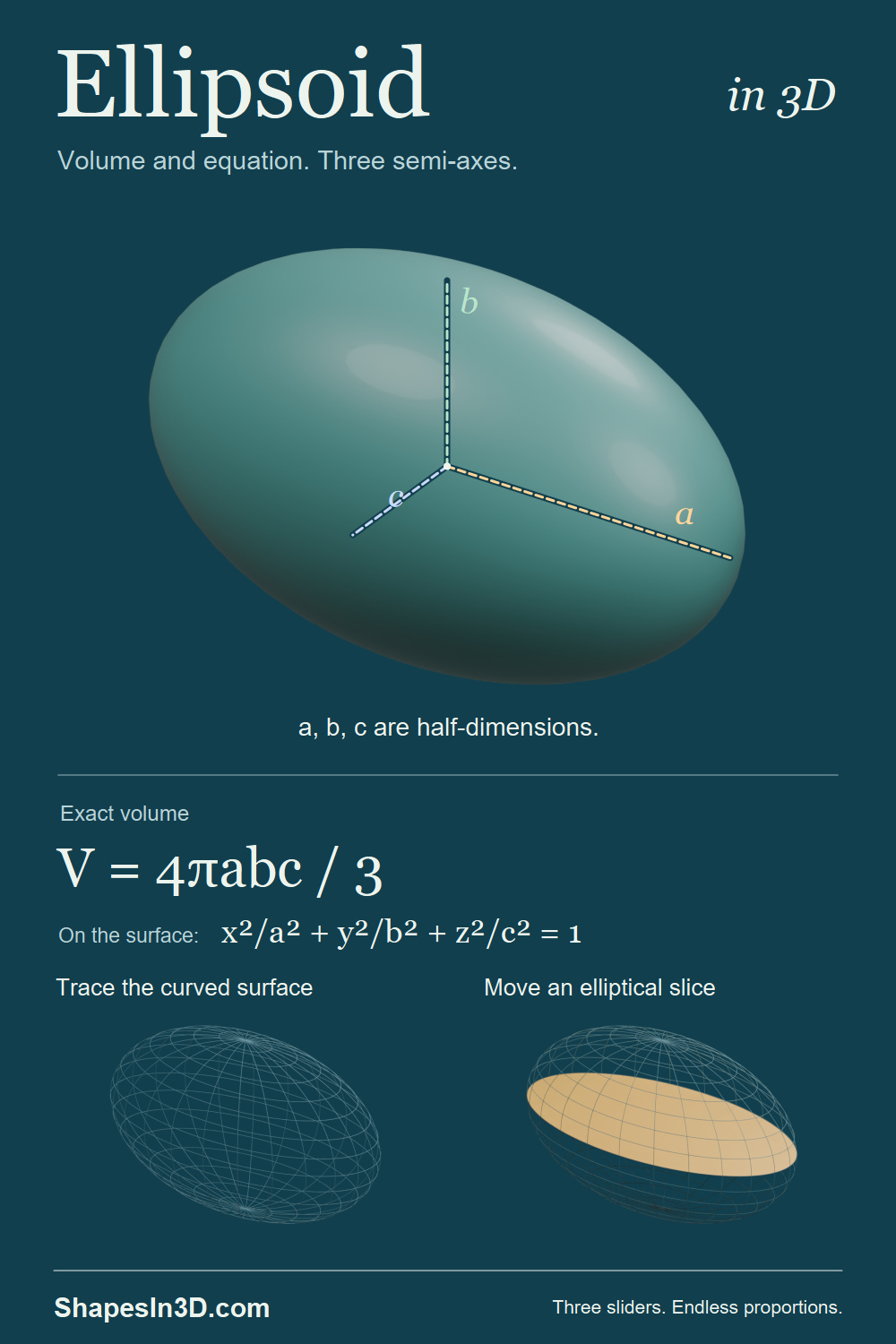
- a · b · c
- Each is a center-to-surface distance.
- V = 4πabc / 3
- The volume formula is exact.
- A smooth surface
- Mesh lines are a drawing aid, not polygonal edges.