
Cone frustum in 3D
A cone with its tip removed.
A cone frustum is the part left between two parallel cuts of a cone. This right circular frustum has aligned circular ends, base radius R, top radius r and perpendicular height h.
On this page5 sections
The top radius cannot exceed the base radius. Units relabel dimensions without conversion.

Loading the interactive model…
Drag to rotate · Pinch or scroll to zoom
Solid view
units³
πh(R² + Rr + r²) / 3units²
Both circular ends plus the curved side.Follow the taper from R to r.


The slope is a right triangle.
The horizontal change in radius is R − r. Together with height h, it forms a right triangle whose hypotenuse is the slant height s.
s = √[h² + (R − r)²]
units
| Measurement | Formula | Result |
|---|---|---|
| Base circle | πR² | units² |
| Top circle | πr² | units² |
| Curved side | π(R + r)s | units² |
| Total area | πR² + πr² + π(R + r)s | units² |
| Volume | πh(R² + Rr + r²) / 3 | units³ |
A frustum slice at fraction t of the height has radius R + t(r − R). Its area changes quadratically with this radius.
Which part of the truncated cone are you measuring?
The tapered side
L = π(R + r)s
units²
The large circular end
B = πR²
units²
The small circular end
T = πr²
units²
Total surface area = L + B + T = units². An open-ended sleeve needs only the curved area L. A container open at the small end needs L + B; it does not include the top circle.
Use perpendicular height for the volume
V = πh(R² + Rr + r²) / 3. The side length s = √[h² + (R − r)²] is longer than h whenever the two radii differ. When R = r, the shape becomes a cylinder and s = h.
Questions about the shape
Does “frustum” always mean a cone?
No. Pyramids can also be truncated. This page specifically models a right circular cone frustum.
What happens when both radii are equal?
The taper disappears and the model becomes a cylinder. The same formulas reduce to the usual cylinder formulas.
Can I use diameters in the radius fields?
Halve each diameter first. R and r are center-to-rim distances.
Read the two radii.
Follow the taper.
The complete cone frustum, its circular slice and the curved side are gathered into one reference.
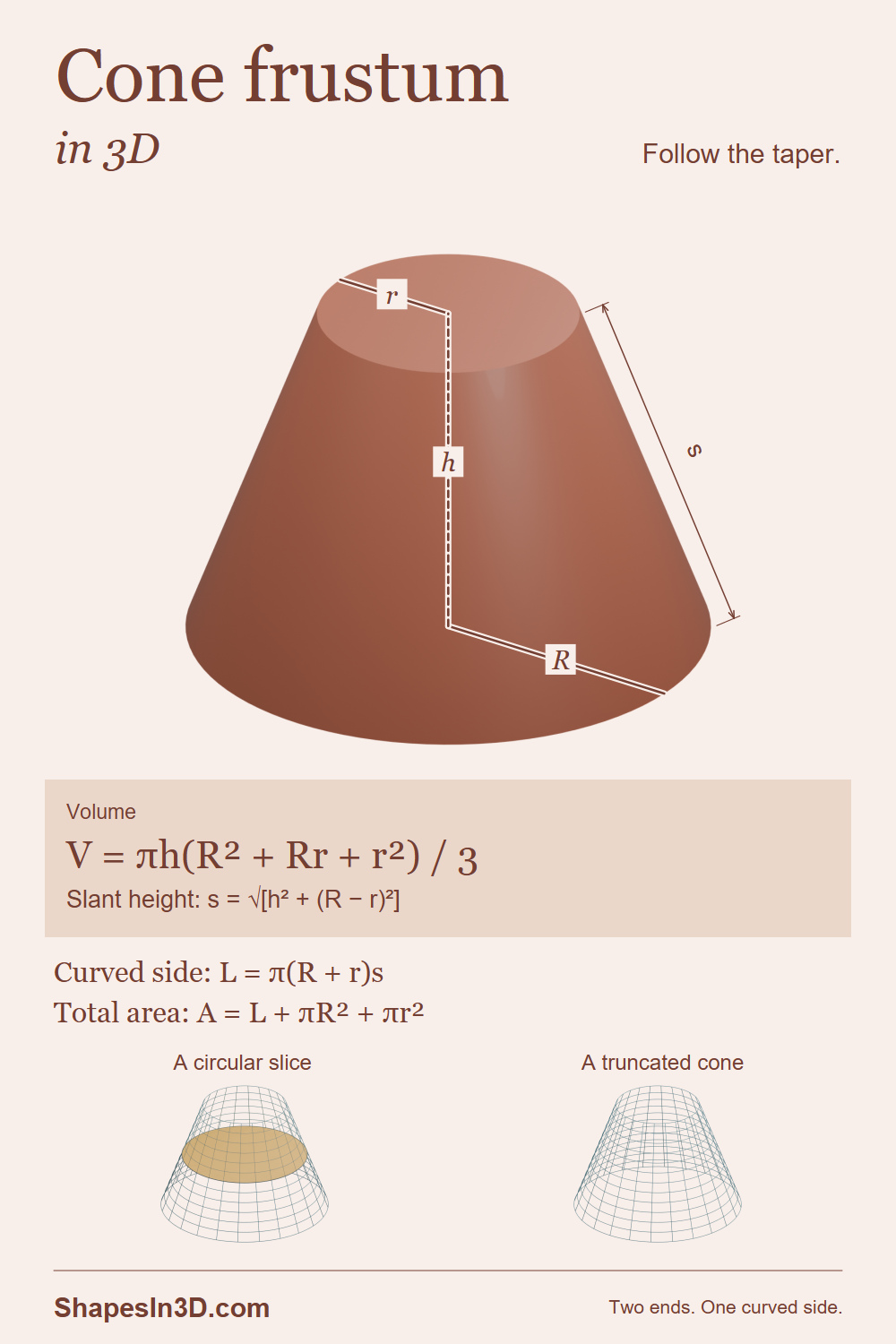
- R and r
- The lower and upper circular radii.
- h and s
- Perpendicular height and slant height describe different lengths.
- V = πh(R² + Rr + r²) / 3
- The volume includes the change in radius along the height.