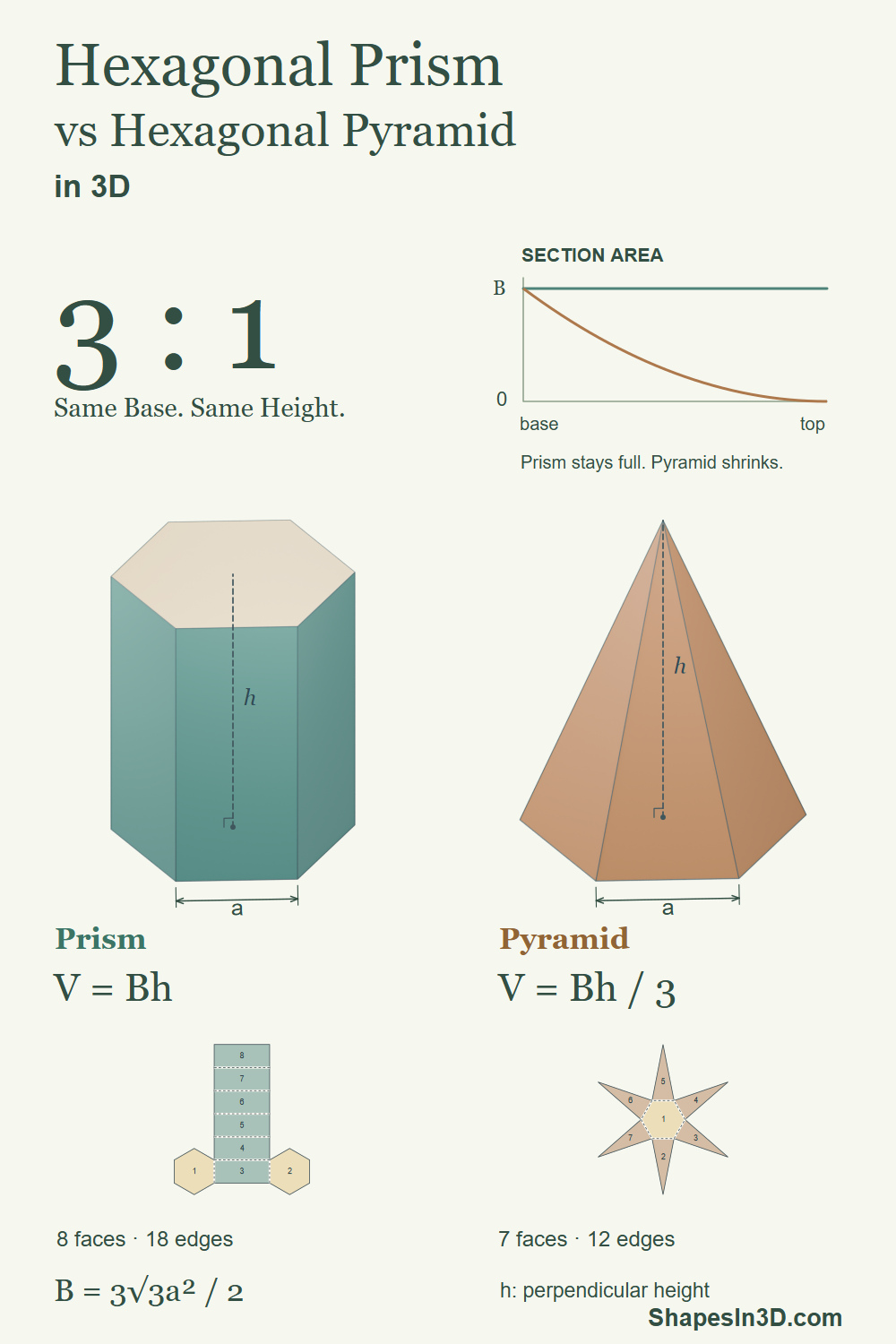
Start with the same regular hexagon and the same perpendicular height. The prism carries
the hexagon all the way up; the pyramid narrows to a point. That difference gives volumes
in the exact ratio 3:1.
Explore This Comparison
Same Hexagon. Same Height.
3 : 1Prism : pyramid volume
Hexagonal Prism
8 faces · 18 edges
Closed solidFlat net
AssembledSeparated
V = Bhcm3
Hexagonal Pyramid
7 faces · 12 edges
Closed solidFlat net
AssembledSeparated
V = Bh / 3cm3
Drag to rotate · Scroll or pinch to zoom · Arrow keys rotate the focused model. Switch off
Link Rotations to move only one shape.
Slice Through the Difference
The prism stays full-width. The pyramid tapers.
Base: 0Halfway: 0.5Top: 1
Halfway up: the pyramid section is ¼ of B. Area scales as (1 − u)².
Prism sectioncm2
Pyramid sectioncm2
Changing units relabels the numbers.
Same regular hexagonal base. Same height. The prism holds three times as much.
Build the Base from Six Triangles
A regular hexagon splits into six equilateral triangles of side a. Its area is
B = 6(√3a²/4) = 3√3a²/2, and its perimeter is
P = 6a. These same base measurements feed both solids.
The prism has volume Bh. The pyramid has volume Bh/3, which also follows by integrating
the shrinking section areas through its height.
From the Shared Base to Two Different Solids
Hexagonal Prism
Volumecm3V = 3√3a²h / 2
One base areaB = 3√3a² / 2
cm2
Lateral surface area6ah
cm2
Total surface area3√3a² + 6ah
cm2
Hexagonal Pyramid
Volumecm3V = √3a²h / 2
Side-face slant heightℓ = √(h² + 3a²/4)
cm
Lateral surface area3aℓ
cm2
Total surface area3√3a²/2 + 3aℓ
cm2
These formulas use a regular hexagonal base, a right prism, and a pyramid whose apex is
above the base center. h is perpendicular height; ℓ is the height of a triangular side
face, not a side edge.
Eight Faces or Seven?
The prism has a second hexagon at its top. In the pyramid, that top face is replaced by an
apex, and its six sides are triangles. The flat nets below keep every face visible.
Properties and face nets
Property
Hexagonal Prism
Hexagonal Pyramid
Faces
8: 2 hexagons + 6 rectangles
7: 1 hexagon + 6 triangles
Edges
18
12
Vertices
12
7
Bases
2 parallel, congruent hexagons
1 hexagon
Parallel cross-section
Constant hexagon
Shrinking hexagon
Volume at the matched settings
Bh
Bh/3
Flat face nets
8 faces. Dashed lines are folds.
7 faces. Dashed lines are folds.
Questions About Hexagonal Solids
Does “hexagonal” mean six faces?
No. It names the six-sided base polygon. A hexagonal prism has eight faces; a
hexagonal pyramid has seven.
Why is the pyramid one-third of the prism?
With the same base area and perpendicular height, any pyramid has one-third of the
corresponding prism’s volume. Its parallel sections shrink quadratically, and adding
them through the height gives Bh/3.
How many edges belong to the prism?
There are six around each hexagonal end and six joining corresponding vertices: 6 + 6
+ 6 = 18.
How many edges belong to the pyramid?
There are six around the base and six running from base vertices to the apex: 6 + 6 =
12.
Is the section halfway up half the base area?
For the pyramid, no. Halfway up, every section length is halved, so the area is
one-quarter of the base area. The prism’s section stays equal to the base area.
Same Hexagon. Three Times the Volume.
Save the complete prism and pyramid, their matched dimensions, volume relationship, and
the contrasting nets of rectangles and triangles.