
Hexagonal prism in 3D
Six sides around a constant section.
A hexagonal prism has two congruent, parallel hexagonal ends. This right regular model joins them with six rectangles. Its base hexagons have six equal sides and six equal angles.
On this page6 sections

Loading the interactive model…
Drag to rotate · Pinch or scroll to zoom
Solid view
- faces
- 8
- edges
- 18
- vertices
- 12
units²
units³
units²
Two hexagons. Six rectangles.


A hexagon is six equal triangles.
Join its center to every vertex. In a regular hexagon, each new triangle is equilateral with the same edge a. Add their areas to get B = 6 × √3a²/4 = 3√3a²/2.
Every slice parallel to the ends has this same area. Multiplying B by the perpendicular height h gives the volume.
Unwrap the side area
6a × h
The six rectangles form a strip with width equal to the base perimeter. Add both hexagons to obtain total surface area.
| Measurement | Formula | Result |
|---|---|---|
| Base area | 3√3a² / 2 | units² |
| Base perimeter | 6a | units |
| Lateral area | 6ah | units² |
| Total surface area | 3√3a² + 6ah | units² |
| Volume | 3√3a²h / 2 | units³ |
The hexagonal prism net is a six-panel belt.
Six rectangles wrap around the prism. The two hexagons close its ends. The belt is 6a wide and h high, so its area is 6ah.

Side belt
L = 6ah
units²
Two ends
Each B = 3√3a² / 2
units² each
All eight faces
S = 2B + L
units²
Questions about the shape
Is every hexagonal prism regular?
No. Its two ends need only be congruent hexagons. This page uses regular hexagons and a right prism so the two controls determine every dimension.
Why are there eight faces?
There are six rectangular sides and two hexagonal ends.
Does rotating it change its height?
No. Here h means the perpendicular distance between the two parallel ends, regardless of the viewing angle.
A hexagon,
all the way through.
The six-sided footprint and the eight-face net connect the assembled prism to its calculations.
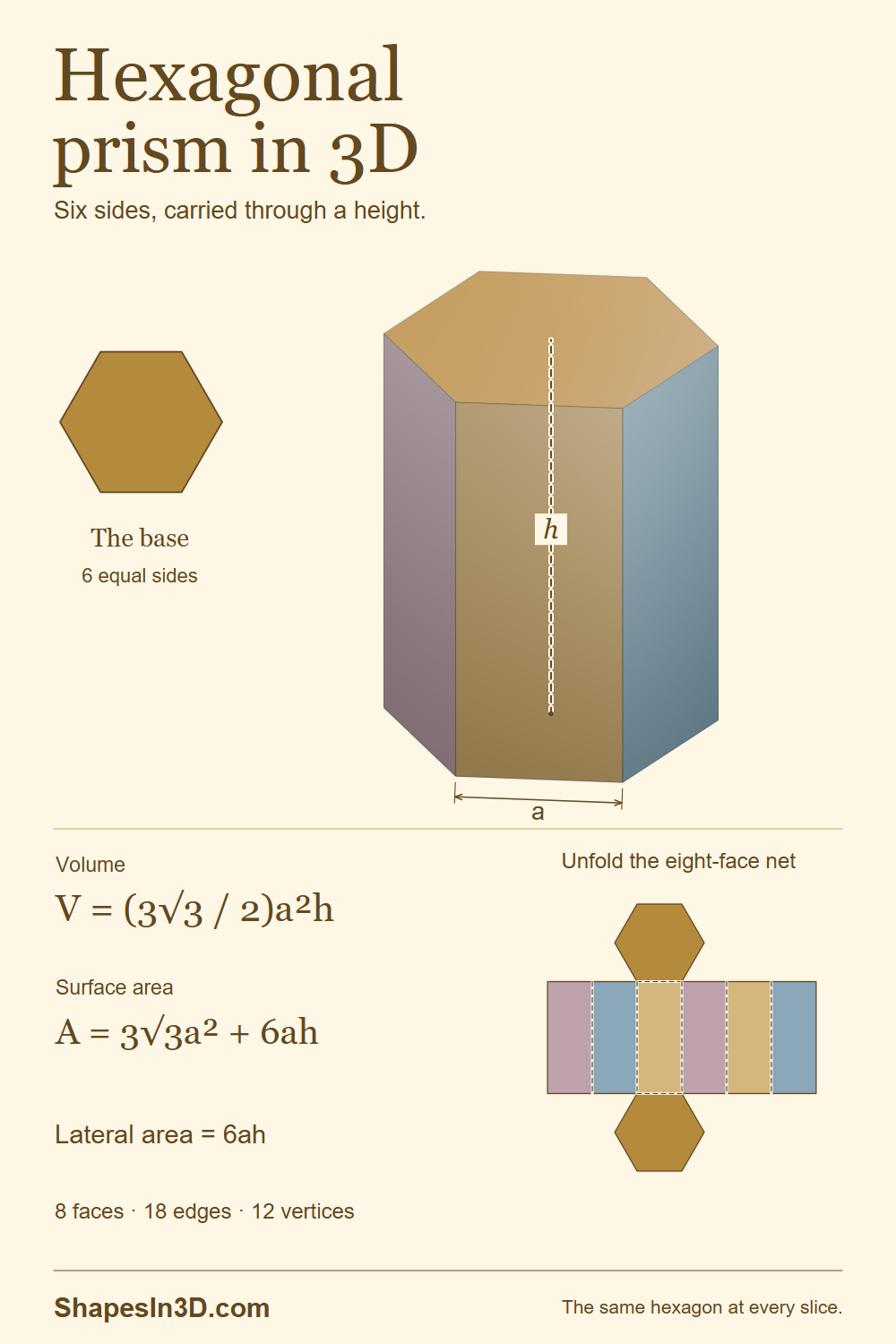
- Two hexagons
- The congruent ends each have area 3√3a²/2.
- Six rectangles
- Together the side walls have area 6ah.
- V = (3√3 / 2)a²h
- Base area multiplied by height gives volume.