
Hexagonal pyramid in 3D
Six triangles meet above a hexagon.
A right regular hexagonal pyramid has a regular hexagonal base and an apex above its center. Six congruent isosceles triangular faces rise to that apex.
On this page6 sections

- faces
- 7
- edges
- 12
- vertices
- 7

Loading the interactive model…
Drag to rotate · Pinch or scroll to zoom
Solid view
Units relabel dimensions without conversion.
units³
units²
units
units²
The hexagon and its six side triangles.


Half the height does not mean half the area.
Halfway from the base to the apex, the parallel hexagonal slice has half the original edge length. Its area is therefore one quarter of the base area.
Move the gold section upward: its shape stays hexagonal while its area falls to zero at the tip.
Bslice = B(1 − t)²
Similar hexagons; different sizes.
| Measurement | Formula | Result |
|---|---|---|
| Base apothem q | √3a / 2 | units |
| Base area | 3√3a² / 2 | units² |
| Slant height ℓ | √(h² + 3a²/4) | units |
| Six triangular sides | 3aℓ | units² |
| Total surface area | 3√3a²/2 + 3aℓ | units² |
| Volume | √3a²h / 2 | units³ |
Six triangles explain the surface area.

The central hexagon contributes the base area B. Each surrounding triangle contributes ½aℓ. Together the six sides have area L = 3aℓ.
- Base apothem q = √3a / 2
- units
- Slant height ℓ = √(h² + q²)
- units
- Lateral area 3aℓ
- units²
Volume: V = Bh / 3 uses vertical height h. Surface area: S = B + 3aℓ uses slant height ℓ.
Questions about the shape
Why are there seven faces?
There is one hexagonal base and six triangular sides.
Are the triangles always equilateral?
No. Their two equal lateral edges depend on h. The regularity here refers to the base and the centered apex.
Which height belongs in the volume formula?
Use the perpendicular height h, measured from the center of the base to the apex, not the slant height ℓ.
Two heights.
Two useful calculations.
The complete model distinguishes perpendicular height from slant height. The net and section explain how volume and surface area use those dimensions.
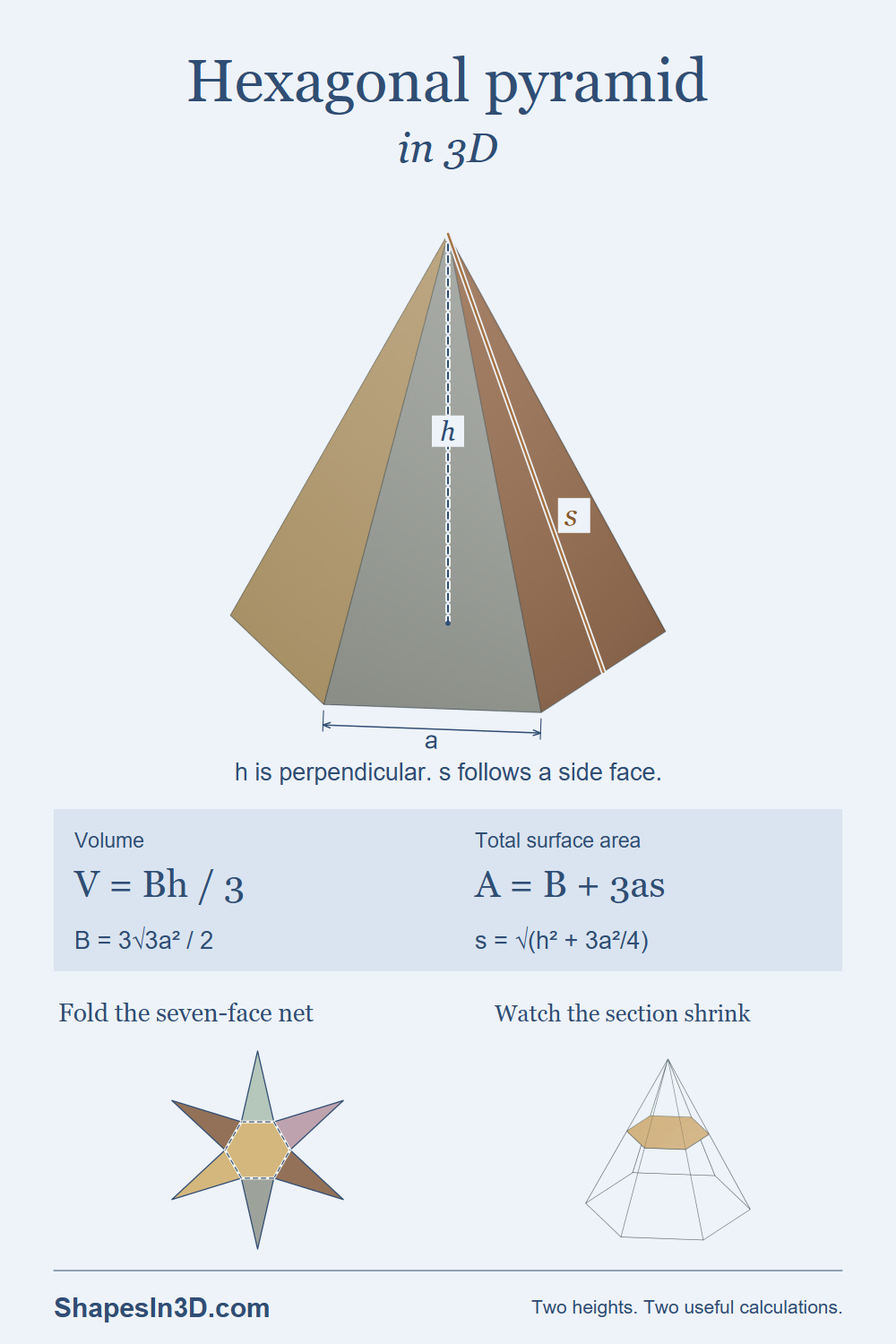
- h · perpendicular height
- Volume is V = Bh/3.
- s · slant height
- Total surface area is A = B + 3as.
- B · base area
- The regular hexagon has area 3√3a²/2.