Icosahedron: 300° Around a Vertex
The gap to 360° is 60°. Five triangles meet to form each corner.

Home Icosahedron vs octahedron
An icosahedron and an octahedron both have equilateral triangular faces. Their difference is the way those triangles meet: five at each icosahedron vertex, four at each octahedron vertex. Start with equal outer radii to compare how they occupy the same surrounding sphere.
20 faces · 30 edges · 12 vertices

8 faces · 12 edges · 6 vertices

Both shapes have the same center-to-vertex radius. Their edge lengths differ.
Drag to rotate · Scroll or pinch to zoom · Arrow keys rotate a focused model. Turn off Link Rotations to spin either shape on its own. Dimensions stay attached to the solid.
The gap to 360° is 60°. Five triangles meet to form each corner.
The gap to 360° is 120°. Four triangles meet to form each sharper corner.
These flat triangle fans show the angle deficit. The complete 3D models show how the triangles tilt together to close the corners.
| Property | Icosahedron | Octahedron |
|---|---|---|
| Faces | 20 | 8 |
| Edges | 30 | 12 |
| Vertices | 12 | 6 |
| Vertex arrangement | 5 triangles | 4 triangles |
| Euler check | 12 − 30 + 20 = 2 | 6 − 12 + 8 = 2 |
| Face nets |
|
|
Equal Edge compares the same triangular building block. Equal Radius fits both sets of vertices on spheres of the same radius. The edge labels update to show the difference.
R = a√(10 + 2√5) / 4
A = 5√3a²
V = 5(3 + √5)a³ / 12
R = a / √2
A = 2√3a²
V = √2a³ / 3
The icosahedron has 12 vertices. The octahedron has 6. Counting the points alone does not tell you the number of faces.
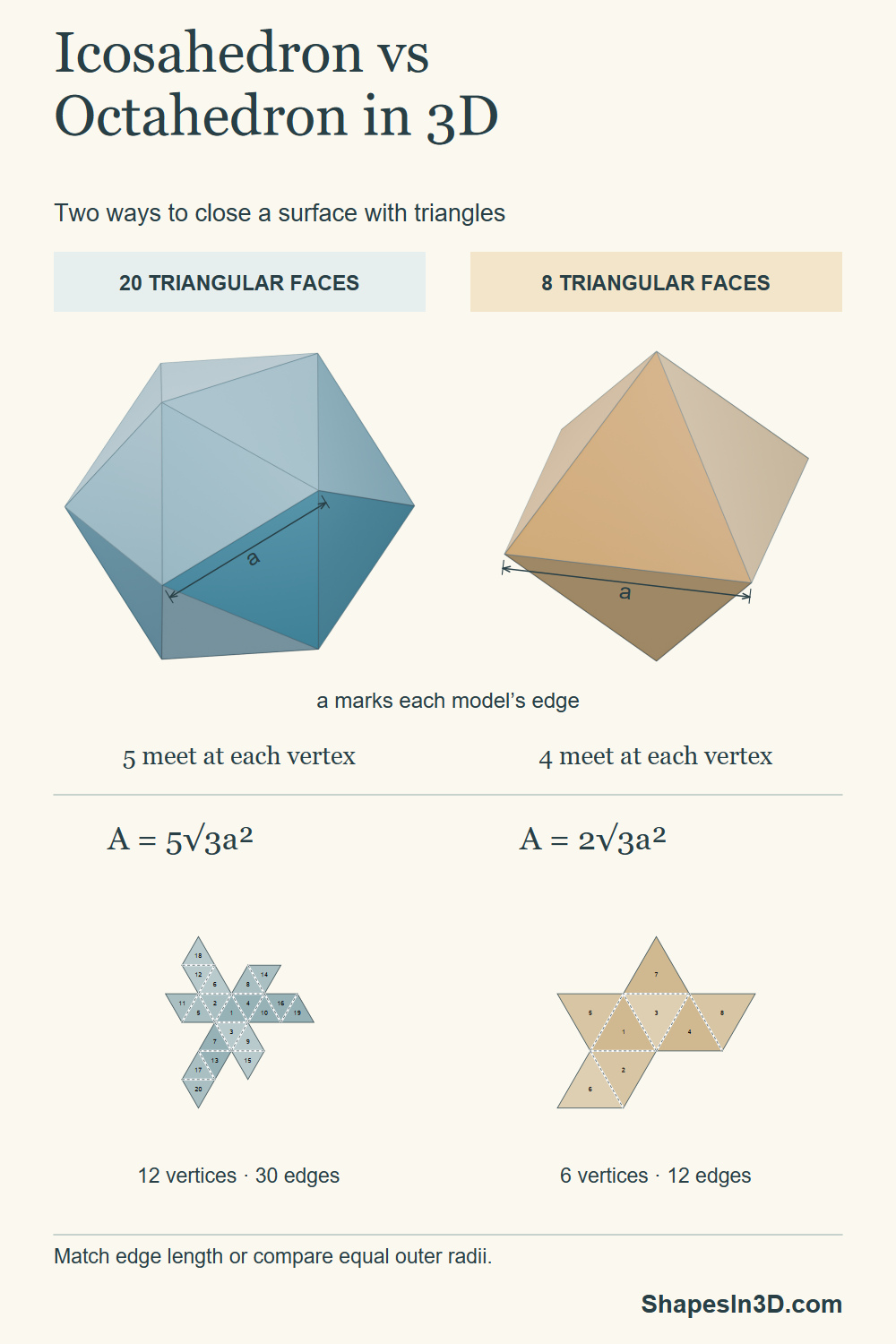
Save the 20-face and 8-face models together with their different corner arrangements and folding nets.
Pin ItView Featured Image