
Icosahedron in 3D
Twenty triangles. A remarkably balanced solid.
An icosahedron is a polyhedron with twenty faces. This model is the regular icosahedron: every face is an equilateral triangle and five faces meet at each vertex.
On this page5 sections

Loading the interactive model…
Drag to rotate · Pinch or scroll to zoom
Solid view
An icosahedron net: twenty triangles, still connected.
Separate faces show the pieces. A net shows how those pieces stay joined. Here, nineteen shared edges act as hinges while the remaining edges open into the flat pattern.
Each equilateral triangle has area √3a² / 4. Twenty copies give the total surface area 5√3a².
20 × 3 ÷ 2 = 30 edges; 20 × 3 ÷ 5 = 12 vertices.

The whole solid and its twenty faces.


Count five around a corner.
Choose a face, then turn the model to a vertex. Five triangular corners meet there. Each contributes 60°, so the angles around that vertex total 300°. The remaining angular gap lets the surface close into a solid.
units²
Twenty copies make the entire surface.
| Measurement | Formula | Result |
|---|---|---|
| Surface area | 5√3a² | units² |
| Volume | 5(3 + √5)a³ / 12 | units³ |
| Center to a vertex | a√(10 + 2√5) / 4 | units |
| Total edge length | 30a | units |
Questions about the shape
Is every icosahedron regular?
No. Twenty faces define an icosahedron. Equal equilateral faces and the same arrangement at every vertex define the regular model shown here.
Is this a sphere?
No. Its twenty flat faces meet along sharp edges. Rotating the model makes those planes easier to see.
What happens when the edge length doubles?
Surface area becomes four times as large and volume becomes eight times as large. The face, edge and vertex counts stay fixed.
Twenty triangles,
one connected net.
The complete 3D solid and its unfolding net connect twenty triangular faces to the volume and surface-area formulas.
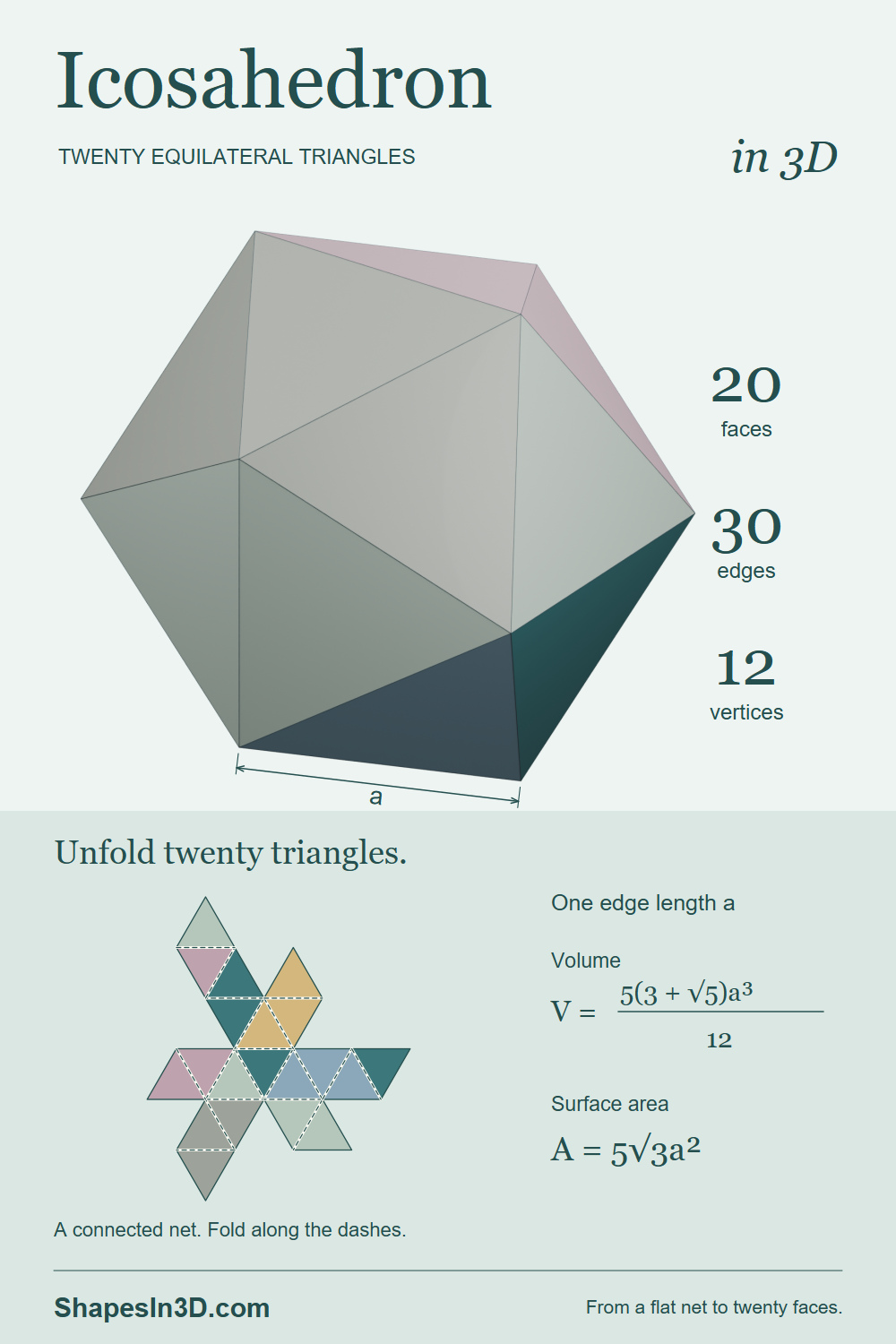
- 20 · 30 · 12
- Faces, edges and vertices.
- A connected net
- Dashed shared edges are the folds.
- a = edge length
- All twenty faces are congruent equilateral triangles.