
Pentagonal Prism vs Pentagonal Pyramid in 3D
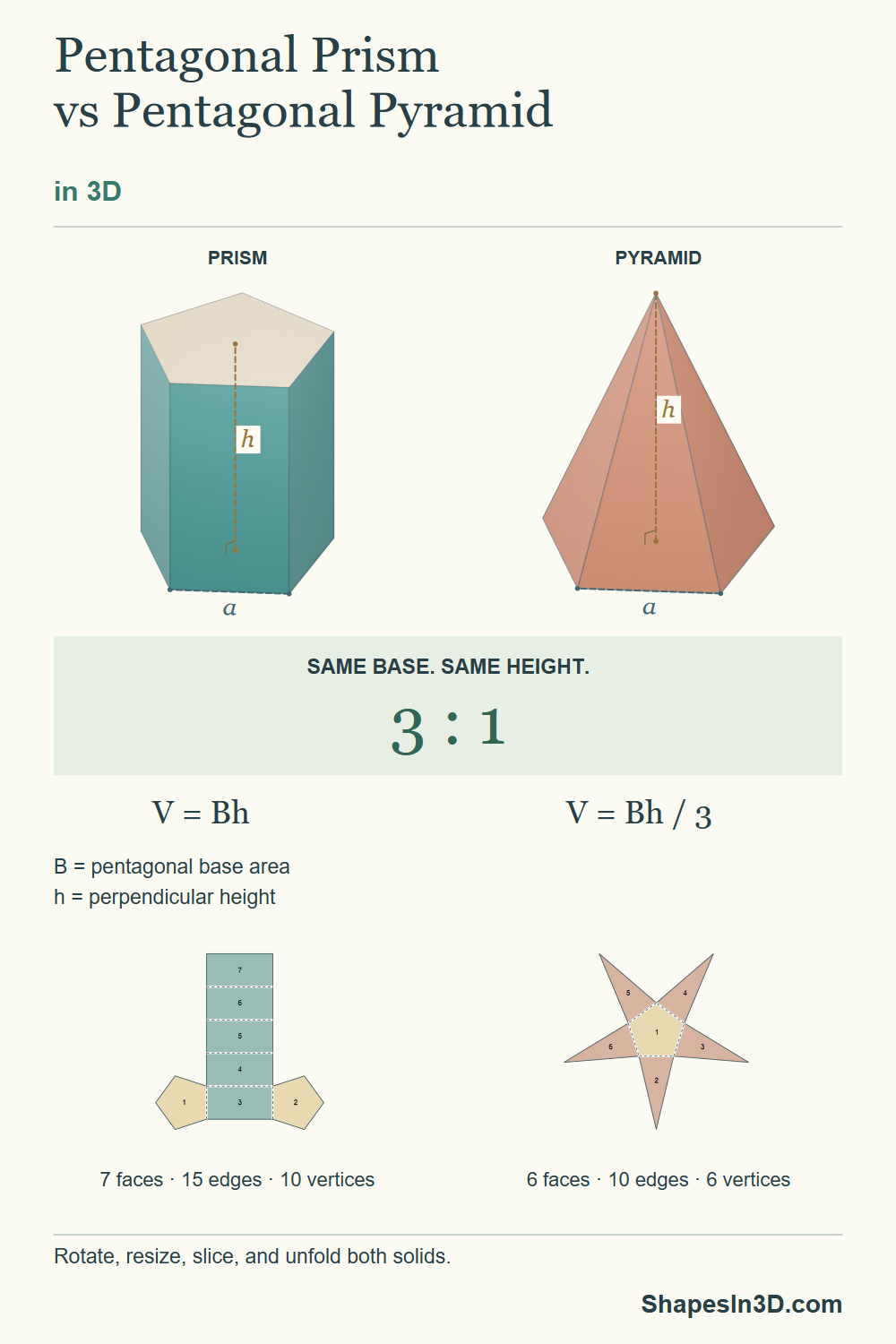
A pentagonal prism keeps the same five-sided cross-section from bottom to top. A pentagonal pyramid narrows from one pentagonal base to an apex. Match their base and height to see exactly where their volume and surface area differ.
Explore This Comparison
Pentagonal Prism
2 pentagons + 5 rectangles

V = Bh
Pentagonal Pyramid
1 pentagon + 5 triangles

V = Bh / 3
Drag to rotate · Scroll or pinch to zoom · Arrow keys rotate a focused model. Turn off Link Rotations to spin either shape on its own. Dimensions stay attached to the solid.
One Base. One Height. Three Times the Space.
This relationship holds for every pair of matching bases and heights, even as you change the sliders.
At a halfway slice, the pyramid has half the linear width and one quarter of the base area. The prism keeps its full base area at every height.
Count the Faces, Then Fold Them
| Property | Pentagonal Prism | Pentagonal Pyramid |
|---|---|---|
| Faces | 7 | 6 |
| Edges | 15 | 10 |
| Vertices | 10 | 6 |
| Bases | 2 congruent, parallel pentagons | 1 pentagon |
| Side faces | 5 rectangles | 5 congruent isosceles triangles |
| Apex | None | 1 |
| Face nets |
|
|
The Side Faces Change the Area
Both models use a regular pentagon. Its apothem p is the perpendicular center-to-side distance. The pyramid’s slant height ℓ runs up the middle of a triangular side; h is its perpendicular height.
Pentagonal Base
p = a / [2 tan(36°)]
B = 5ap / 2
Prism Surface Area
A = 2B + 5ah
Pyramid Surface Area
ℓ = √(h² + p²)
A = B + 5aℓ / 2
Does a pentagonal pyramid have five faces?
It has six: one pentagonal base and five triangular sides. The name describes the base, not the total number of faces.
Why do the nets look different?
A prism’s five rectangles make a belt with a pentagon at each end. A pyramid’s five triangles meet at one apex when folded.
Keep the Pentagon Comparison
The featured image pairs complete solids with their flat nets and the shared-base volume relationship.
Pin ItView Featured Image