Across the base
The apothem q ends at the midpoint of a pentagon side. It is perpendicular to that side.
Apothem q
units

Home Pentagonal pyramid
Five equal sides converge at one apex.
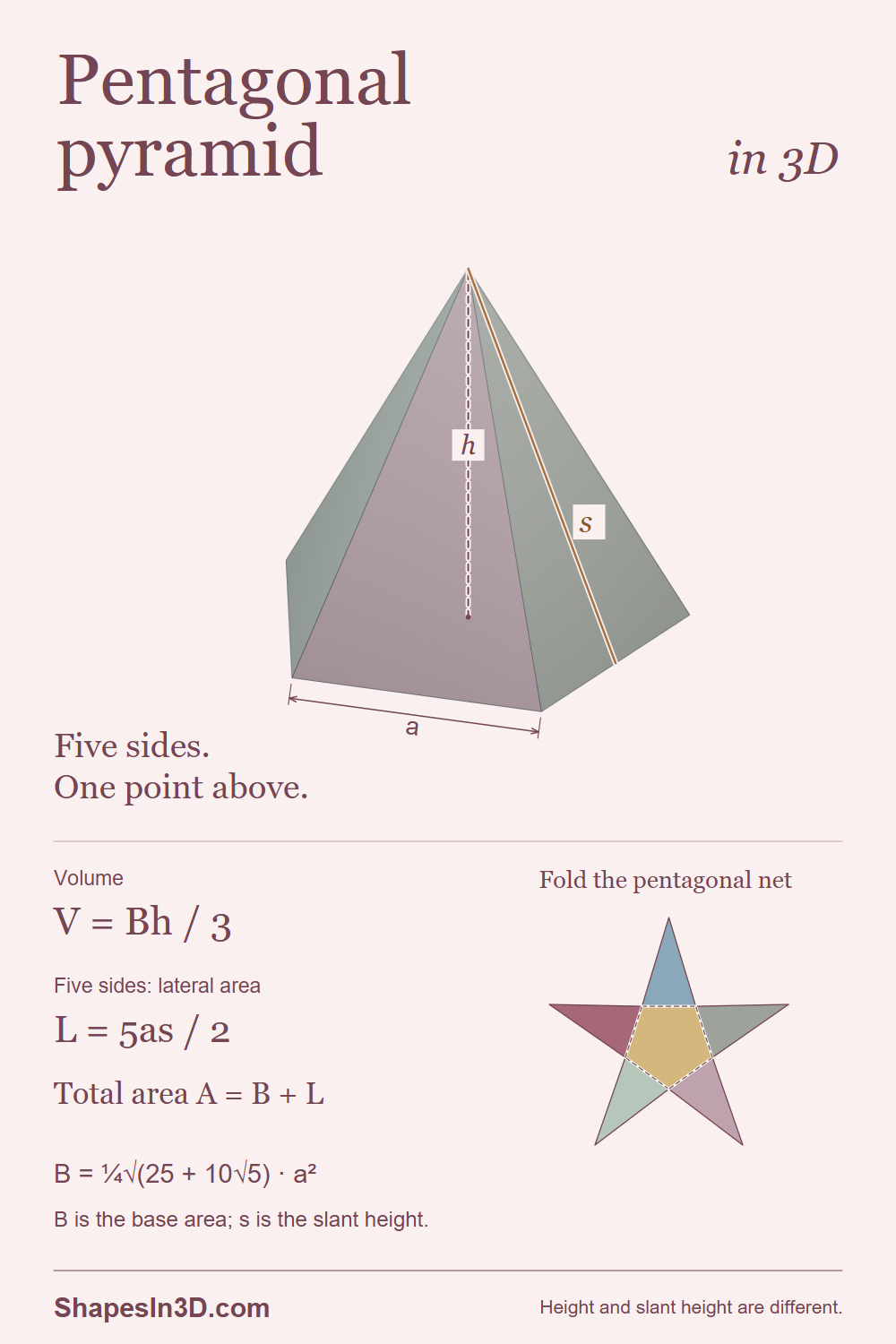
This right regular pentagonal pyramid places its apex over the center of a regular pentagon. Its five side faces are congruent isosceles triangles, and its sixth face is the pentagonal base.

Loading the interactive model…
Drag to rotate · Pinch or scroll to zoom
Solid view


The apothem q ends at the midpoint of a pentagon side. It is perpendicular to that side.
units
The vertical height h ends at the apex. It is perpendicular to the whole base plane.
V = ⅓Bh
The slant height ℓ runs from the apex to a base-edge midpoint, inside a triangular face.
units

Use q to find the base area, h for the volume, and ℓ for the side area. The lateral edge goes to a base corner and is longer than ℓ.
units
| Measurement | Formula | Result |
|---|---|---|
| Pentagonal base B | 5a² / [4 tan(36°)] | units² |
| Slant height ℓ | √(h² + q²) | units |
| Triangular side area | 5aℓ / 2 | units² |
| Total surface area | B + 5aℓ/2 | units² |
| Volume | Bh / 3 | units³ |
Lateral area includes only the five triangles. Total surface area also includes the pentagonal base. This distinction matters when a question asks for just the sides.
Five side triangles
L = 5aℓ / 2
units²
Include the base
S = L + 5aq / 2
units²
Here q is the base apothem and ℓ = √(h² + q²) is the slant height. The current slant height is units.

No. A prism has two pentagonal ends. This pyramid has one pentagonal base and one apex.
The side triangles become taller along their faces, increasing their slant height and therefore their area.
Five lateral edges meet there, one from each base vertex.
Keep lateral area separate from total area, and read the perpendicular and slant heights on the assembled pyramid.