Is a Cube a Rectangular Prism?
Yes. Its opposite faces are parallel, every face is a rectangle, and every corner is a right angle. More specifically, all six faces are congruent squares.

Home Prism vs cube
A cube is a special rectangular prism: all its edges have the same length. Both shapes have six rectangular faces, twelve edges, and eight vertices. Change the dimensions below to see what stays the same and what makes a cube different.
Three independent dimensions

One edge length sets every side

Length, width, and height are all a. Moving this slider changes all three together.
Drag to rotate · Scroll or pinch to zoom · Arrow keys rotate the focused model. Turn off Link Rotations to explore one shape at a time.
This rectangular prism is not a cube: its three dimensions are not all equal.
A rectangle has four right angles. A square is a rectangle with four equal sides, so six square faces still satisfy the definition of a rectangular prism. The extra condition is equality: L = W = H = a.
Yes. Its opposite faces are parallel, every face is a rectangle, and every corner is a right angle. More specifically, all six faces are congruent squares.
No. It becomes a cube only when length, width, and height are equal. Try Make It a Cube above, then change just one prism dimension to break that equality.
Volume counts cubic units inside the solid. Surface area adds the areas of all six faces. Opposite faces of a rectangular prism come in matching pairs: LW, LH, and WH. In a cube, each pair becomes a², giving 6a².
Lateral area excludes the top and bottom faces, with H used as the prism height. The space diagonal connects opposite vertices through the interior. Select Diagonal on either model to see it. Results are rounded to two decimal places.
These nets use the dimensions selected above. The prism has three matching pairs of rectangles; the cube has six equal squares. The gold pair marks the chosen parallel bases. Select Net on either model and fold its faces independently.
| Property | Rectangular prism | Cube |
|---|---|---|
| Face shapes | 6 rectangles in 3 matching pairs | 6 congruent squares |
| Edge lengths | L, W, and H; four edges of each length | All 12 edges have length a |
| Right angles | Every face corner is 90° | Every face corner is 90° |
| Vertices | 8; three edges meet at each | 8; three edges meet at each |
| Bases | 2 parallel, congruent rectangles | 2 parallel, congruent squares |
| Flat face nets |
|
|
In this comparison, yes. A cuboid means a solid with six rectangular faces. Some everyday descriptions use “cuboid” for a box that is not a cube, but a cube satisfies the broader mathematical definition.
Yes. If two dimensions are equal, one pair of opposite faces is square. All six faces are squares only when all three dimensions are equal.
Yes. A cube with edge 4 has volume 64 cubic units. A 8 × 4 × 2 rectangular prism also has volume 64, but their surface areas differ: 96 and 112 square units.
Apply the Pythagorean theorem twice: the square face diagonal is a√2, then the interior diagonal is √((a√2)² + a²) = a√3. This is longer than a face diagonal.
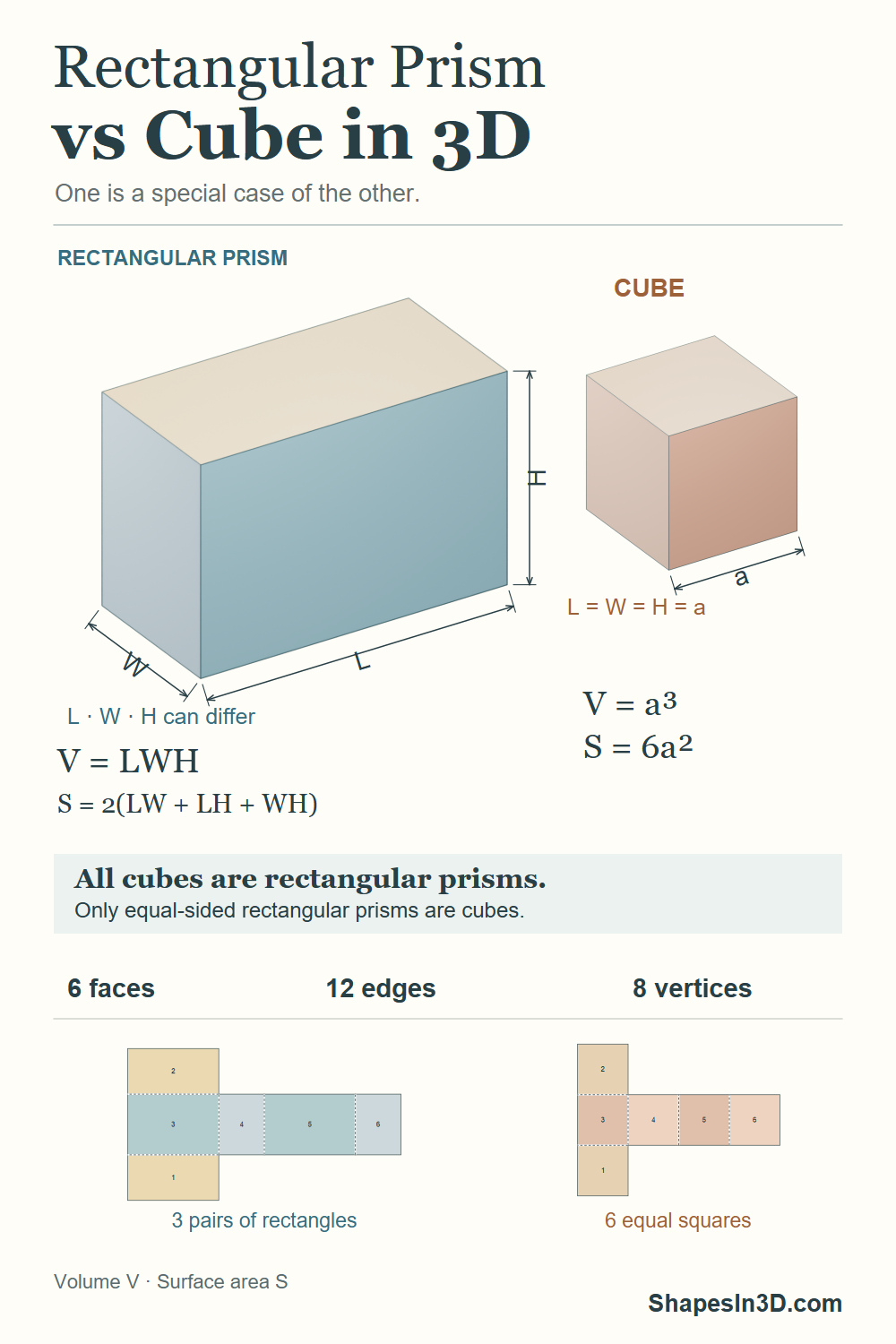
Keep the complete shapes, labeled dimensions, volume and surface area formulas, and both face nets together in one featured image.
Pin ItView featured image