
Rectangular Prism in 3D
Change the length, width and height. Explore the shape and calculate its volume, surface area and more.
On this page7 sections
Interactive 3D model
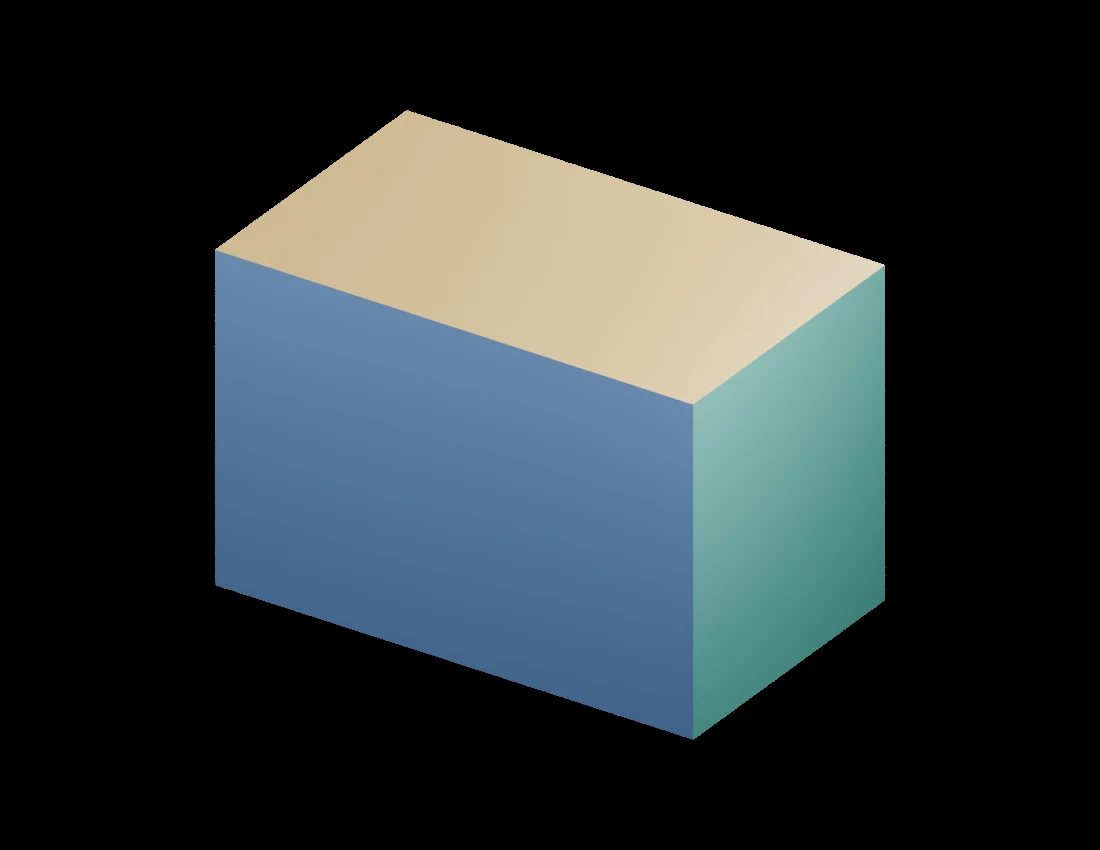 A rectangular prism has 6 faces, 12 edges and 8 vertices.
Calculation results
Volume, surface area & more
For 6 × 3.6 × 4 units
Volume
units³
V = l × w × h
6 × 3.6 × 4
The space inside the prism.
Total surface area
units²
A = 2(lw + lh + wh)
2 × (6 × 3.6 + 6 × 4 + 3.6 × 4)
The combined area of all six faces.
Lateral surface area
units²
Alateral = 2h(l + w)
2 × 4 × (6 + 3.6)
The four sides, excluding top and bottom.
Show base area, space diagonal & total edge length
Base area
units²
B = l × w
6 × 3.6
The length × width face is the base.
Space diagonal
units
d = √(l² + w² + h²)
√(6² + 3.6² + 4²)
The distance between opposite corners.
Total edge length
units
E = 4(l + w + h)
4 × (6 + 3.6 + 4)
The lengths of all twelve edges added together.
Four sides or all six faces?
Lateral surface area counts the four side walls: 2h(l + w). Total surface area adds the matching top and bottom: 2lw + 2h(l + w). Choose the base as the length × width rectangle to keep these labels consistent.
For the current box, one base has area units²; the four walls have area units². Two bases plus the walls give units².
Results update as you adjust the dimensions. Displayed values are rounded to three decimal places.
What is a rectangular prism?
A rectangular prism is a three-dimensional solid with six rectangular faces. It is also called a cuboid. Opposite faces have the same size and shape, and are parallel.
Length (l) runs from end to end, width (w) from front to back, and height (h) from bottom to top. Change their proportions in the model above; it still has 6 faces, 12 edges and 8 vertices. When all three dimensions are equal, it is a cube.
One solid. Six rectangular faces.

Faces, edges and vertices
Select a part below to highlight it on the model.
Properties of a rectangular prism
Right angles
Adjacent edges meet at 90°. Every face is a rectangle, so each face has four right angles.
Three matching pairs
The front and back match. The left and right match. The top and bottom match.
How it differs from a cube
A cube is a rectangular prism whose length, width and height are all equal. Its six faces are squares.
Net of a rectangular prism
A net is a flat arrangement of the prism's six rectangular faces. Folding the rectangles along their shared edges makes the closed solid. The model shows one possible net; move the folding slider to see the connection between the flat rectangles and the three-dimensional shape.
Three lengths.
Every face accounted for.
Read the volume and total area, then use the net and matching faces to see how four side walls differ from all six faces.
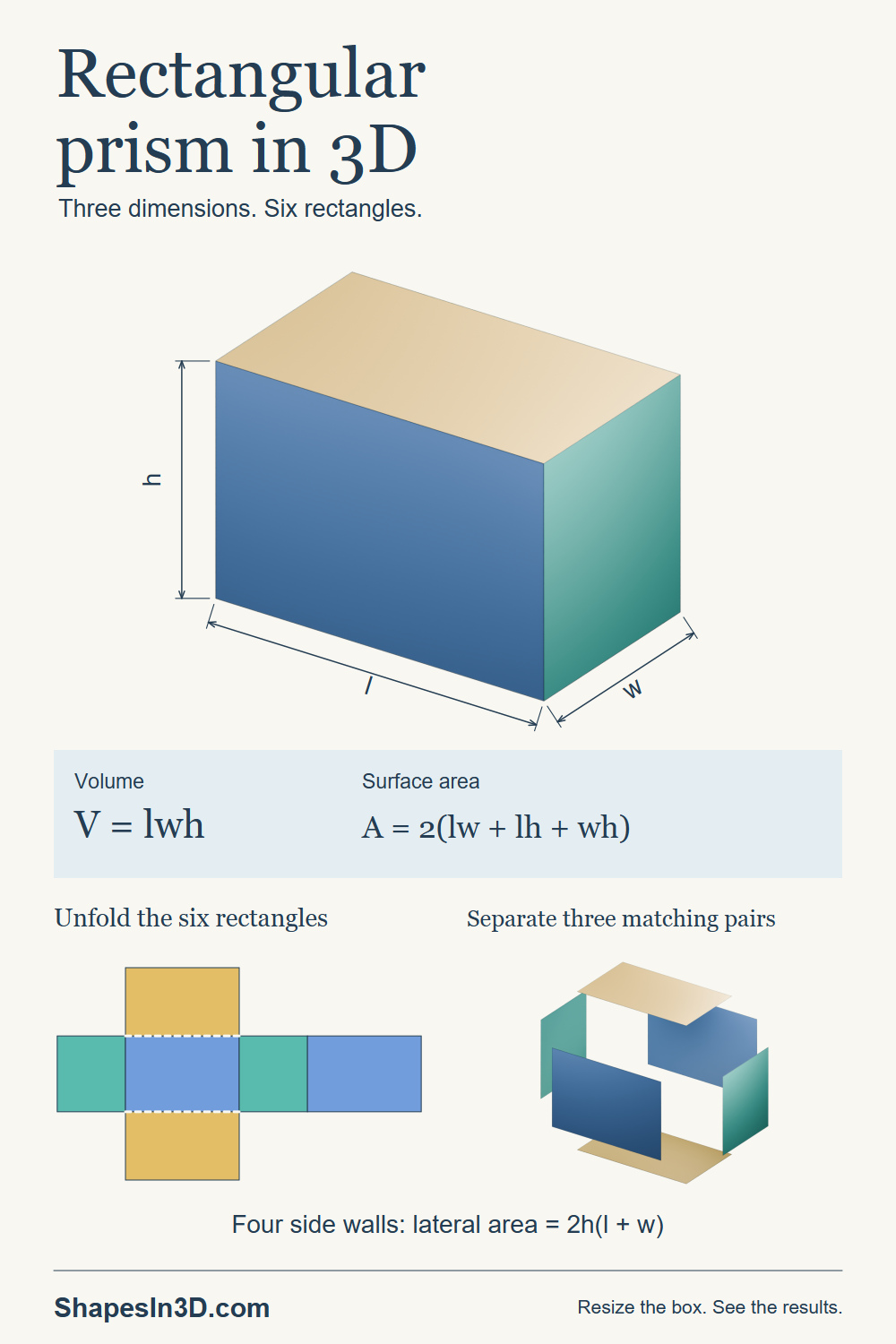
- l · w · h
- Length, width and perpendicular height.
- V = lwh
- The three dimensions give the volume.
- Lateral area = 2h(l + w)
- The four side walls exclude the top and bottom.