Same Edge
When both base edges are a, the square’s area is a² and the equilateral triangle’s area is √3a²/4. At equal heights, the square pyramid has about 2.31 times the volume.

Home Square vs triangular
The base changes the face count. A square pyramid has one square base and four triangular sides. A triangular pyramid has one triangular base and three triangular sides. Both taper to an apex and follow V = Bh/3.
1 square + 4 triangular sides

1 triangle + 3 triangular sides

Drag to rotate · Scroll or pinch to zoom · Arrow keys rotate the focused model. Switch off Link Rotations to move only one shape.
Equal base edges do not give equal base areas. The square base is larger.
When both base edges are a, the square’s area is a² and the equilateral triangle’s area is √3a²/4. At equal heights, the square pyramid has about 2.31 times the volume.
The triangular base edge expands to 2a/√(√3), so its area matches the square. Equal base areas and equal perpendicular heights give equal volumes, despite different face counts.
Both models have a regular base and an apex above its center. The perpendicular height h goes straight to the base plane. Slant height ℓ lies on a side face, from the apex to the midpoint of that face’s base edge.
Here s means the triangular base edge displayed above. In Same Base Edge mode, s = a. In Same Base Area mode, s is larger. These side-area formulas use the centered apex and regular bases shown.
Each base edge supports one triangular side. The square pyramid therefore has four side triangles, while the triangular pyramid has three. Separate the faces or fold the nets to count them directly.
| Property | Square Pyramid | Triangular Pyramid |
|---|---|---|
| Base | 1 square | 1 triangle |
| Triangular side faces | 4 | 3 |
| Total faces | 5 | 4 |
| Edges | 8 | 6 |
| Vertices | 5 | 4 |
| Other name | A pyramid with a quadrilateral square base | Tetrahedron |
| Volume rule | Bh/3 | Bh/3 |
| Flat face nets |
|
|
No. A tetrahedron has four triangular faces. A square pyramid has five faces, including a square base.
No. Volume depends on base area and perpendicular height. Use Same Base Area above to make these two pyramids have equal volumes at equal heights.
No. Its base is equilateral in this model, but its side edges need not equal the base edge. It is a regular tetrahedron only when h = s√(2/3).
No. That formula requires the perpendicular height. Slant height belongs in the side-triangle area calculation.
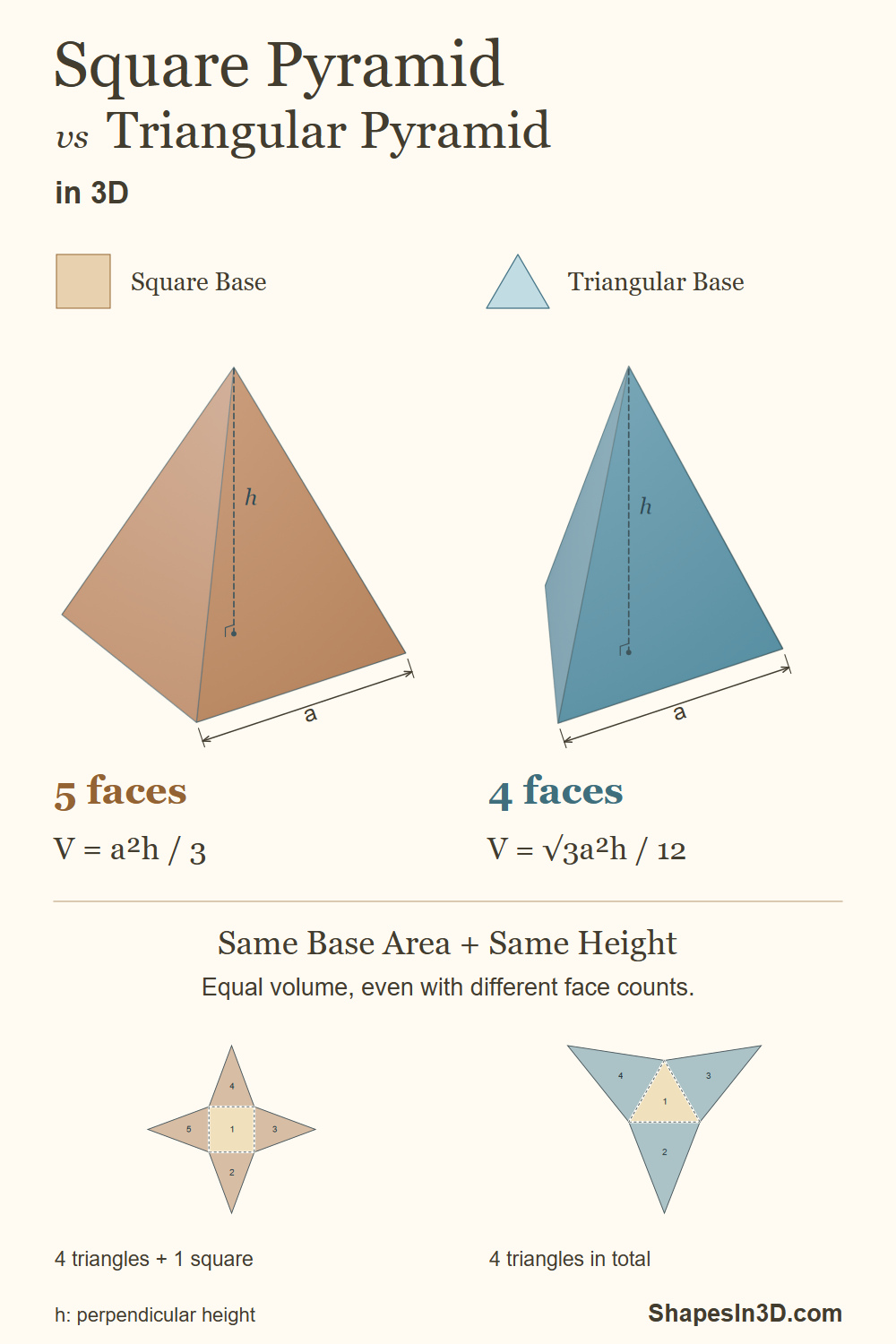
A square and a triangle lead to different face counts. The featured image keeps the complete pyramids, perpendicular heights, and face nets visible together.
Pin ItView Featured Image