
Tetrahedron vs Octahedron in 3D
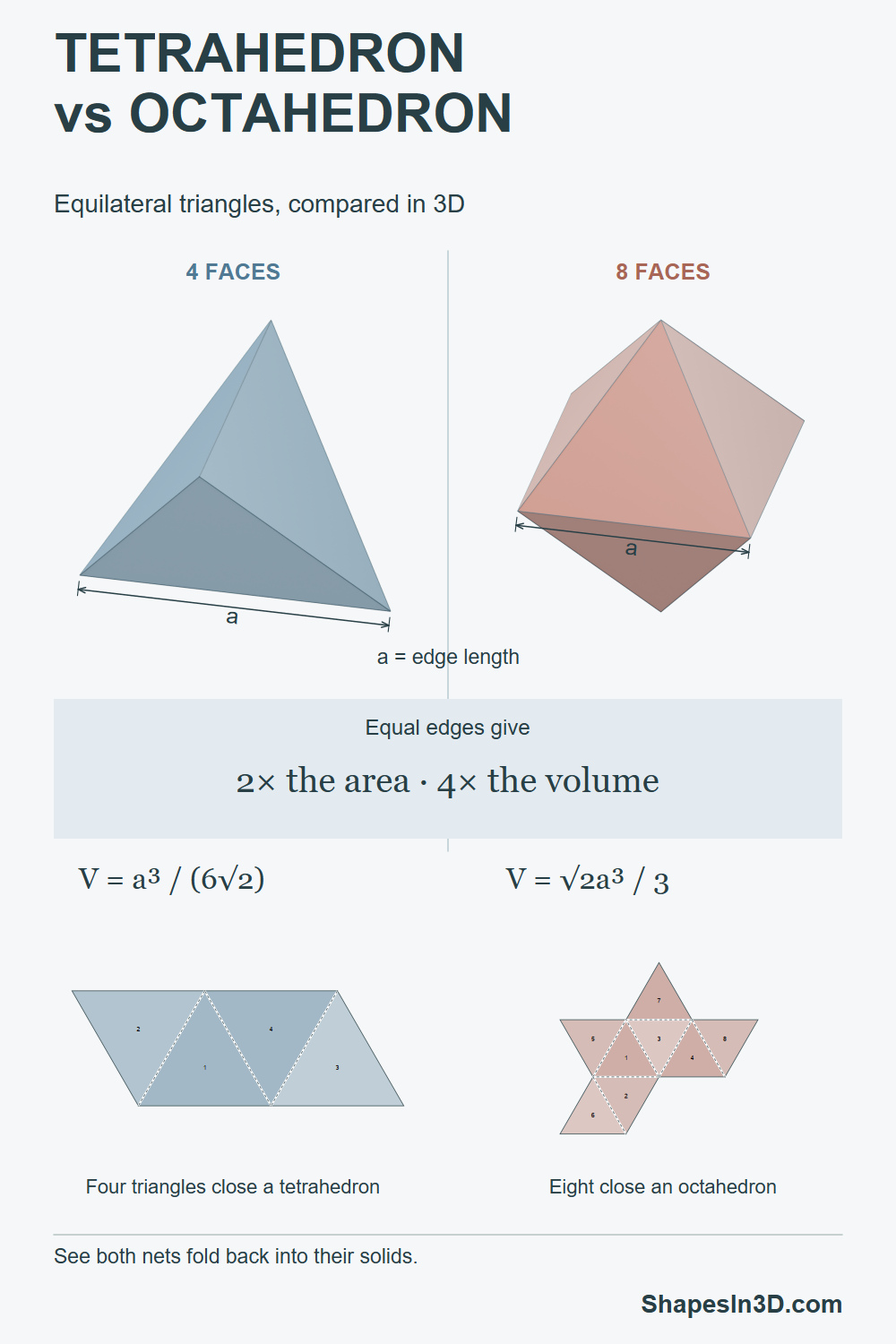
Both solids are made entirely of equilateral triangles. A regular tetrahedron uses four; a regular octahedron uses eight. Twice as many faces does not mean twice the volume: with equal edge lengths, the octahedron holds four times as much.
Explore This Comparison
Choose a Fair Comparison
Both shapes use the same edge length a.
Tetrahedron
3 triangles meet at each vertex

V = a³ / (6√2)
Octahedron
4 triangles meet at each vertex

V = √2a³ / 3
Drag to rotate · Scroll or pinch to zoom · Arrow keys rotate a focused model. Turn off Link Rotations to spin either shape on its own. Dimensions stay attached to the solid.
The Same Triangle Builds Two Different Solids
Every face has area √3a² / 4.
Four Triangles Close a Tetrahedron
Three faces meet at each of its four corners. There are no opposite, parallel faces.
Eight Triangles Close an Octahedron
Four faces meet at each of its six corners. The octahedron can also be seen as two square pyramids joined at their bases.
Double the Area. Four Times the Volume.
These ratios require equal edge lengths. Select Equal Edge above to compare one shared triangle size. Switching to Equal Radius changes the ratios.
Surface Area at Equal Edges
2√3a² / (√3a²) = 2
Volume at Equal Edges
(√2a³ / 3) / [a³ / (6√2)] = 4
Current octahedron / tetrahedron volume ratio: 4.
Two Nets Made of Equilateral Triangles
| Property | Tetrahedron | Octahedron |
|---|---|---|
| Faces | 4 triangles | 8 triangles |
| Edges | 6 | 12 |
| Vertices | 4 | 6 |
| Triangles at each vertex | 3 | 4 |
| Surface area | √3a² | 2√3a² |
| Face nets |
|
|
Are both regular Platonic solids?
Yes. Every face is a congruent regular triangle, and the same number of faces meets at every vertex within each solid.
Is an octahedron two tetrahedra?
No. Splitting a regular octahedron across its middle square gives two square pyramids, each with a square base and four triangular sides.
Save the Triangle Pair
Four faces and eight faces are shown at equal visual weight, with a separate net for each solid and the equal-edge formulas.
Pin ItView Featured Image