A Tetrahedron
Any non-degenerate solid bounded by four triangular faces. Its triangles do not need to be equal, and its apex need not be above the center of the chosen base.

Home Tetrahedron vs pyramid
These are two names for the same family of solids. Every tetrahedron is a triangular pyramid, with four triangular faces. A regular tetrahedron adds a stricter rule: all six edges are equal, so all four faces are equilateral triangles.
All six edges are equal.

h = a√(2/3)
Change the height and apex.

V = Bh / 3
Drag to rotate · Scroll or pinch to zoom · Arrow keys rotate the focused model. Switch off Link Rotations to move only one shape.
Tetrahedron = Triangular Pyramid. The first name counts four faces; the second describes a triangular base and an apex. Move the apex above and sideways to see what changes.
Both models are tetrahedra. Only the left one is necessarily regular.
Any non-degenerate solid bounded by four triangular faces. Its triangles do not need to be equal, and its apex need not be above the center of the chosen base.
A tetrahedron with six equal edges and four congruent equilateral faces. It is a Platonic solid. Its height cannot vary independently while its edge length stays fixed.
The same general solid viewed as a pyramid. Choose any one of its four triangles as the base; the remaining vertex is the apex. Changing that choice does not change the solid.
For any triangular pyramid, V = Bh/3. Here B is the chosen base area, and h is the perpendicular distance from the apex to the base plane. Moving the apex sideways at the same height changes the side faces but does not change the volume.
The general triangular pyramid need not have an equilateral base. This model uses one to isolate the effect of apex position. Surface areas are calculated from the actual triangles, including when the apex is offset.
The regular model unfolds into four equal equilateral triangles. The adjustable model keeps four triangles, but the three sides can differ. The gold triangle is the chosen base; it is not an extra face.
| Property | Regular Tetrahedron | Triangular Pyramid |
|---|---|---|
| Faces | 4 congruent equilateral triangles | 4 triangles; not necessarily congruent |
| Edges and vertices | 6 edges · 4 vertices | 6 edges · 4 vertices |
| Equal edge lengths | All six equal | Not required |
| Possible bases | Any of the four faces | Any of the four faces |
| Volume | Bh/3; also a³/(6√2) when regular | Bh/3 for any triangular base |
| Flat face nets |
|
|
Yes. A triangular base plus three triangular side faces gives exactly four triangular faces. This is a tetrahedron.
Only a regular tetrahedron must. “Tetrahedron” by itself does not require equal edges or congruent faces.
No. The perpendicular height runs from the apex to the base plane at a right angle. A sloping side edge usually has a different length.
At fixed base area and perpendicular height, no. The volume stays Bh/3 even when the apex moves sideways. The side areas can change.
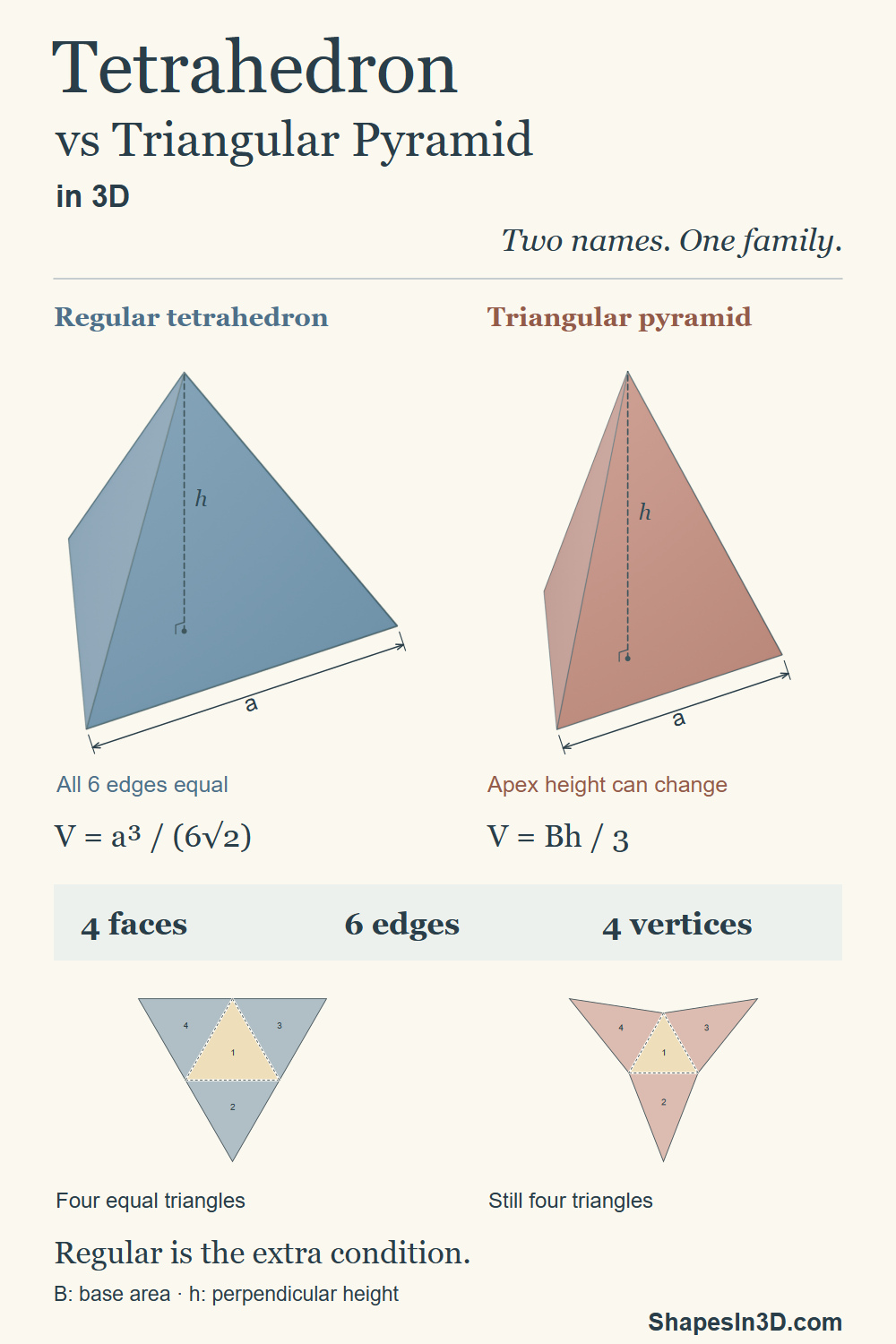
Save the distinction between a general triangular pyramid and a regular tetrahedron, with labeled heights, volume formulas, and both nets.
Pin ItView Featured Image