
Torus vs Sphere in 3D
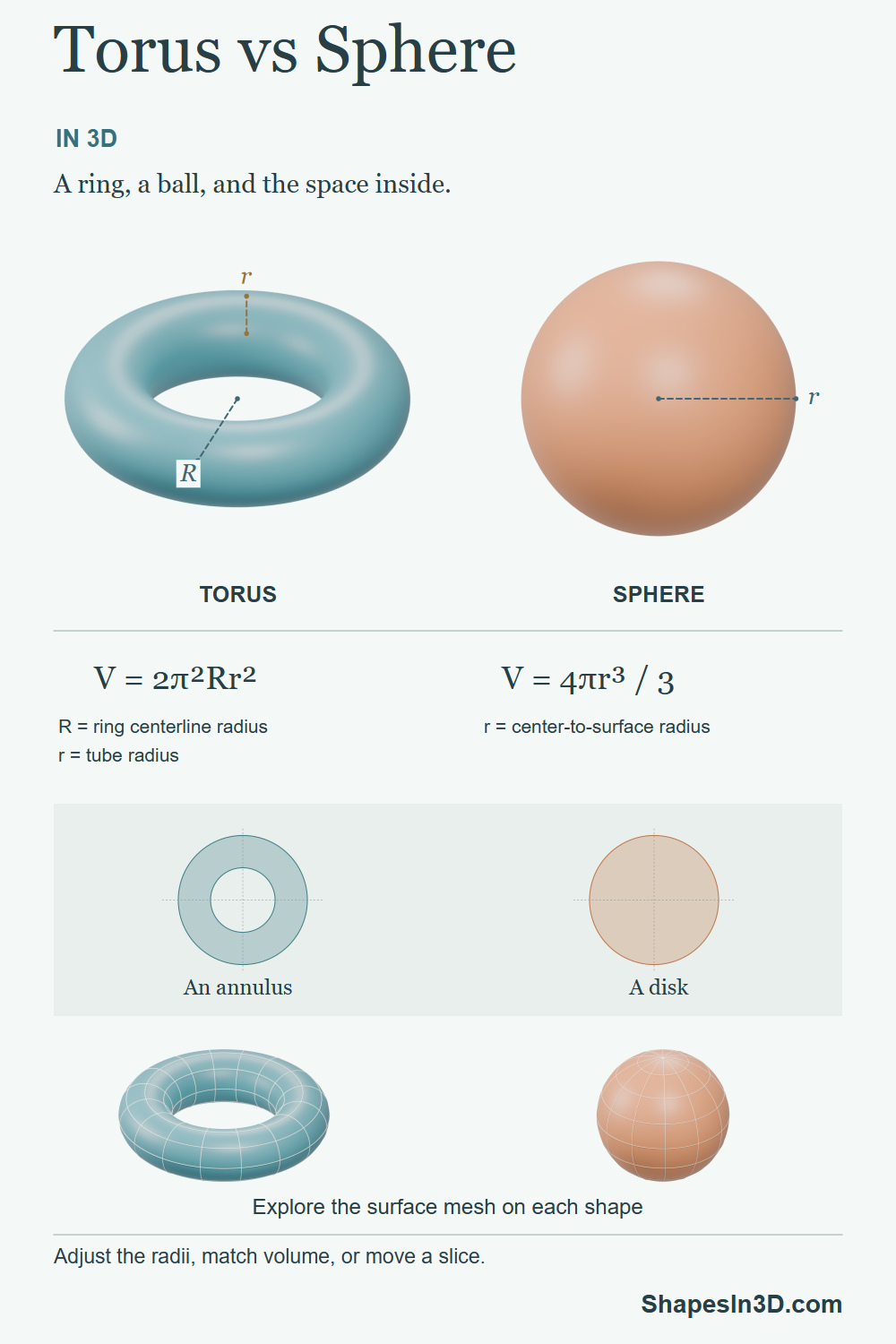
A sphere has one center-to-surface radius. A ring torus is built by moving a circular tube around a larger circle, leaving a hole through the middle. Explore their radii, surface meshes, and horizontal slices without confusing the tube radius with the hole size.
Explore This Comparison
Torus
R: center to tube center · r: tube radius

V = 2π²Rr²
Sphere
r: center to the sphere surface

V = 4πr³ / 3
Drag to rotate · Scroll or pinch to zoom · Arrow keys rotate a focused model. Turn off Link Rotations to spin either shape on its own. Dimensions stay attached to the solid.
A Ring on One Side. A Disk on the Other.
Slice Both Surfaces
The slider uses the same fraction of each shape’s vertical radius. The torus leaves an annular section around the hole; the sphere gives a circular disk.
At the top or bottom of the torus tube, the annulus collapses to a circle of zero area. A sphere’s extreme slice shrinks to one point.
Where Does a Point Belong?
Torus Around the y-Axis
(√(x² + z²) − R)² + y² = r²
Sphere Centered at the Origin
x² + y² + z² = r²
Both formulas describe the surface. A smaller left-hand value places the point inside the tube or ball.
Two Curved Surfaces, Different Topology
| Property | Torus | Sphere |
|---|---|---|
| Through-holes | 1 | 0 |
| Genus | 1 | 0 |
| Polyhedral edges and vertices | None | None |
| Surface area | 4π²Rr | 4πr² |
| Radius meanings | Outer: R + r Hole: R − r |
Every center-to-surface radius is r |
| Cross-sections |
|
|
A sphere and a ring torus cannot be flattened into exact, undistorted paper nets. Their mesh lines mark curved surface coordinates; they are not physical edges. This model keeps R > r, so the torus always has an open hole.
Save the Ring and the Sphere
Separate R and r labels show the two torus dimensions clearly. The featured image also includes surface meshes, sections, and volume formulas.
Pin ItView Featured Image