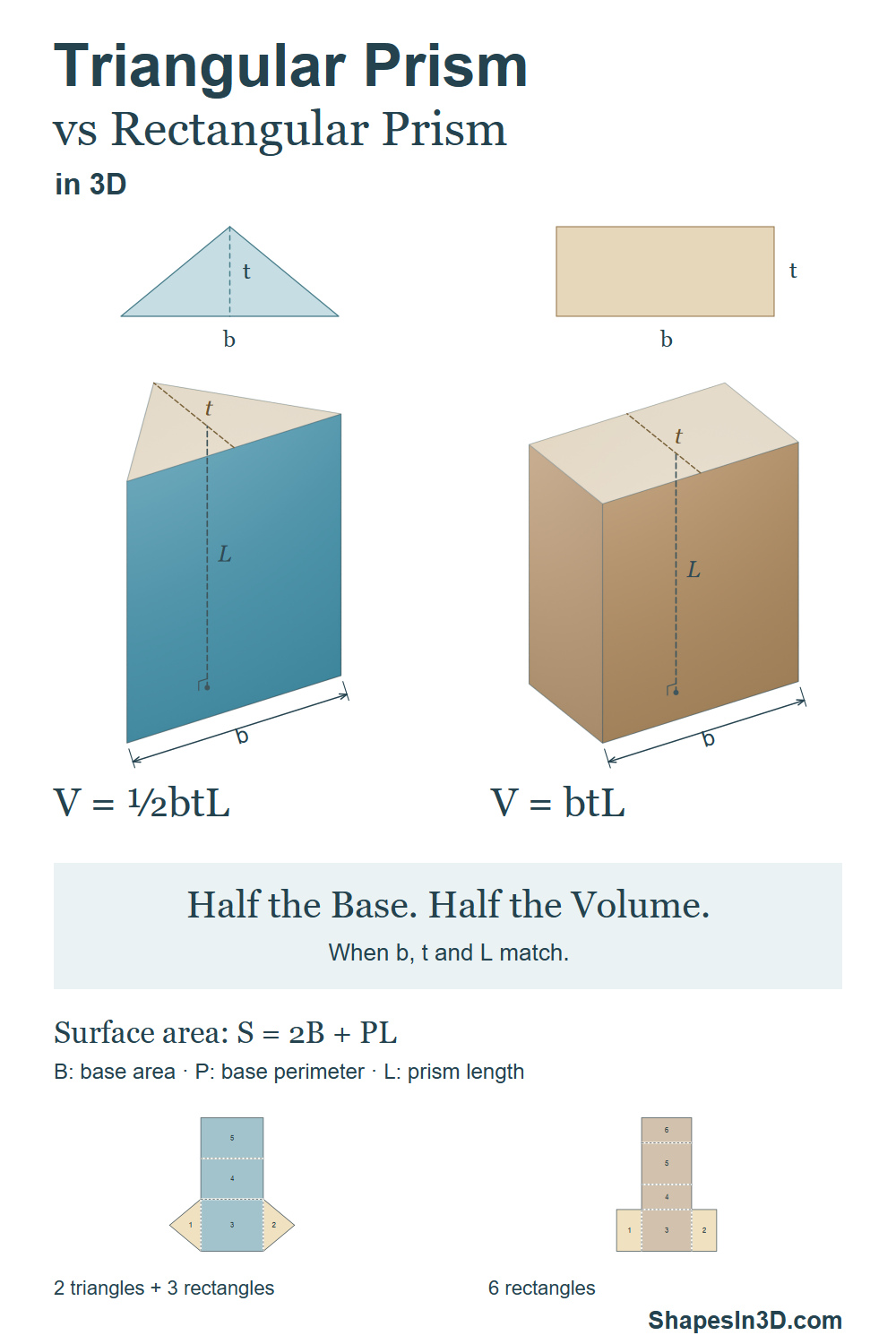
A prism carries the same cross-section from one end to the other. Start with a triangle or
a rectangle, then extend it through length L. The base shape changes the faces and area;
the volume rule remains V = BL.
Explore This Comparison
Triangular Prism
5 faces · 9 edges · 6 vertices
Closed solidFlat net
AssembledSeparated
Volumecm3V = ½btL
Rectangular Prism
6 faces · 12 edges · 8 vertices
Closed solidFlat net
AssembledSeparated
Volumecm3V = btL
Drag to rotate · Scroll or pinch to zoom · Arrow keys rotate the focused model. Switch off
Link Rotations to move only one shape.
Changing units relabels the numbers.
For the same base width, base height, and length, the triangular prism holds exactly half as
much.
Half the Base Area. Half the Volume.
For the matching dimensions used here, the triangle occupies half the rectangle’s area.
Extruding both through the same length keeps that 1:2 relationship. This ratio is a
result of the matched dimensions, not a rule for arbitrary prisms.
The triangular model uses an isosceles triangle. Both models are right prisms, so their
lateral faces are rectangles.
B = ½btB = bt
A Prism Does Not Taper
Slide a plane parallel to the ends. Every interior section has the same area as the
base.
Base: 0Halfway: 0.5Top: 1
Triangle:
cm2Rectangle:
cm2
Volume and Surface Area, Side by Side
Surface area includes both bases and the rectangular strip around them:
S = 2B + PL, where P is the base perimeter. Base height t and
prism length L are different measurements.
Triangular Prism
Base areaB = bt / 2
cm2
Base perimeterP = b + 2√((b/2)² + t²)
cm
Lateral surface areaPL
cm2
Total surface area2B + PL
cm2
VolumeBL = btL / 2
cm3
Rectangular Prism
Base areaB = bt
cm2
Base perimeterP = 2(b + t)
cm
Lateral surface area2L(b + t)
cm2
Total surface area2(bt + bL + tL)
cm2
VolumebtL
cm3
The Base Determines the Face Inventory
A triangular prism has two triangular ends and three rectangular sides. A rectangular
prism has two rectangular ends and four rectangular sides. The nets below resize with the
controls; folding preserves every face’s shape.
Properties and face nets
Property
Triangular Prism
Rectangular Prism
Base shape
Triangle
Rectangle
Faces
5: 2 triangles + 3 rectangles
6 rectangles
Edges
9
12
Vertices
6
8
Parallel matching bases
2
2
Cross-section parallel to base
Constant triangle
Constant rectangle
Flat face nets
5 faces. Dashed lines are folds.
6 faces. Dashed lines are folds.
Common Questions About Prisms
Do both shapes use length × width × height?
A rectangular prism does. For this triangular prism, first multiply the triangular
base’s width and perpendicular height and divide by two, then multiply by the prism
length.
Can a triangular prism have the greater volume?
Yes, if its dimensions are larger. The exact 1:2 ratio on this page applies only while
b, t, and L are matched as shown.
Are the rectangular sides the bases?
The defining bases of a triangular prism are its two parallel congruent triangles. A
rectangular prism has three pairs of opposite rectangular faces, so a suitable pair
can be chosen as its bases.
Why is prism height sometimes called length?
Both refer to the perpendicular distance between the bases of a right prism. This page
calls it L to distinguish it from the height t of the triangular base.
The Base Makes the Difference
Keep the triangle-to-rectangle comparison, labeled dimensions, matched-volume formulas,
and both nets in one featured image.