Triangular prism
The same triangle at both ends.

SolidFlat net
5 faces9 edges6 vertices
Volume
units3
V = BH

Home Prism vs pyramid
Two triangular ends or one base and an apex? Rotate the complete shapes and compare their faces, nets, dimensions and measurements.
The same triangle at both ends.
units3
Three side faces meet at one point.

units3
A net lays every face flat without stretching it. Use the slider below each shape to fold that net independently. The gold triangles mark the bases; dashed lines mark the hinges.
Same triangle. Same perpendicular height. Always.
Both bases are the same isosceles triangle. Its height t lies in the triangle. The solid height H is perpendicular to the base.
These models show a right prism and a pyramid with its apex over the base centroid. The pyramid is not generally a regular tetrahedron. Measurements use the displayed units.
Adjust the dimensions above to update every answer below. Start with the triangular base, then compare the space inside each shape and the area covering its surface.
B = ½ × 6 × 4 = units2
The triangle height t is measured within the base. It is different from the perpendicular solid height H.
B × H = × 6
2B + PH
Lateral area PH units2
Lateral area counts the three rectangles only. Here each equal triangle side is s = √((b/2)² + t²) = , and the base perimeter P = b + 2s = .
B × H ÷ 3 = × 6 ÷ 3
B + A₁ + A₂ + A₃
Lateral area A₁ + A₂ + A₃ units2
The side-face heights are ℓ₁ = and ℓ₂ = . These are slant heights measured along the faces. Use perpendicular H for volume; use each face’s slant height for surface area.
The apex is directly above the base centroid, so ℓ₁ = √(H² + (t/3)²) and ℓ₂ = √(H² + (bt/(3s))²). The two slant heights generally differ. A single shared slant height works only when the base is equilateral in this centered model.
All lengths use the same unit. Areas use square units; volumes use cubic units. Results are rounded to two decimal places.
| Compare | Triangular prism | Triangular pyramid |
|---|---|---|
| Triangular bases | Two congruent, parallel triangles | One triangle, opposite an apex |
| Faces | 5: 2 triangles + 3 rectangles* | 4: all triangles |
| Flat face netDashed lines are folds. |
|
|
| Edges / vertices | 9 edges / 6 vertices | 6 edges / 4 vertices |
| Volume |
V = BH units3 |
V = BH / 3 units3 |
| Total surface area |
S = 2B + PH units2 |
S = B + A₁ + A₂ + A₃ units2 |
| Parallel slices | Same triangle and area at every level | Smaller triangles toward the apex |
B is one triangular base area; P is its perimeter. A₁, A₂ and A₃ are the three pyramid side-face areas. *The side faces are rectangles for a right prism; they are parallelograms for an oblique prism.
A tent with triangular ends and a straight, level ridge approximates a triangular prism. A four-sided die is a familiar triangular pyramid: a regular tetrahedron. The adjustable pyramid above need not have equal edges, so it is more general than that die.
A triangular prism has 5 faces, 9 edges and 6 vertices. A triangular pyramid has 4 faces, 6 edges and 4 vertices. Use the edge and vertex views above to inspect them. Every edge is shared by two faces and is counted once.
Yes. A tetrahedron has four triangular faces. A regular tetrahedron is a special case with four equilateral faces and six equal edges. Changing this pyramid’s height does not change its four-face structure.
Only when their base areas and perpendicular heights are equal. That is why these models share both dimensions. Without those conditions, either solid could have the larger volume.
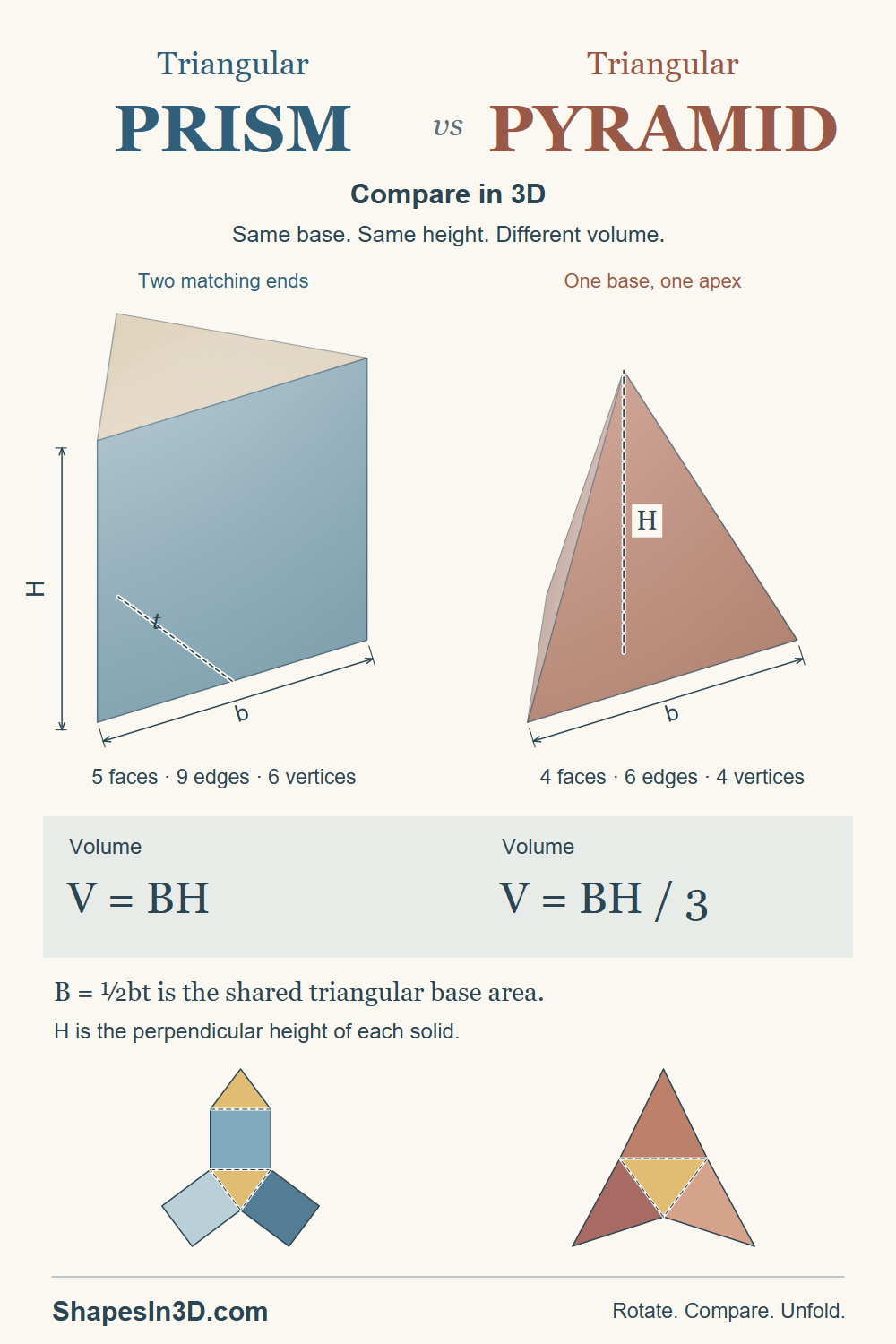
Two complete solids, the same triangle, and two different ways to enclose space. The reference brings the dimension labels, face counts, nets and volume formulas together.