
Truncated icosahedron in 3D
Twelve pentagons. Twenty hexagons.
The truncated icosahedron is the familiar polyhedral pattern associated with a traditional football. Its faces are flat regular polygons: twelve pentagons and twenty hexagons, with three faces meeting at every vertex.
On this page6 sections
One pentagon and two hexagons meet at each vertex.

Loading the interactive model…
Drag to rotate · Pinch or scroll to zoom
Solid view
Units relabel dimensions without conversion.
units²
units³
A net of the truncated icosahedron.
The football pattern opens into 12 pentagons and 20 hexagons. This is a net of the flat-faced polyhedron; a real ball’s curved panels are a different surface.

Why there are 90 edges
(12 × 5 + 20 × 6) ÷ 2 = 90. The division by two removes the double count at every shared edge. One pentagon and two hexagons meet at each of the 60 vertices.
The complete pattern, opened into face families.


From twelve corners to thirty-two faces.
Begin with an icosahedron and cut each of its twelve vertices one third of the way along every incident edge. Each cut creates a pentagon. Each original triangular face becomes a hexagon.
The new solid has sixty vertices and ninety edges. Every edge has the same length.
units²
units²
| Measurement | Formula | Result |
|---|---|---|
| Surface area | [30√3 + 3√(25 + 10√5)]a² | units² |
| Volume | (125 + 43√5)a³ / 4 | units³ |
| Center to a vertex | a√(58 + 18√5) / 4 | units |
| Total edge length | 90a | units |
Questions about the shape
Is it exactly a ball?
No. This geometric solid has flat faces and sharp edges. A manufactured inflated ball has curved panels.
Can two pentagons share an edge?
Not in this solid. Every pentagon is surrounded by five hexagons.
Are all the faces the same size?
All edges are equal, but a regular hexagon has more area than a regular pentagon with that edge length.
Unfold the
football pattern.
The complete solid stays above a connected net of pentagons and hexagons, with a simple shared-edge calculation.
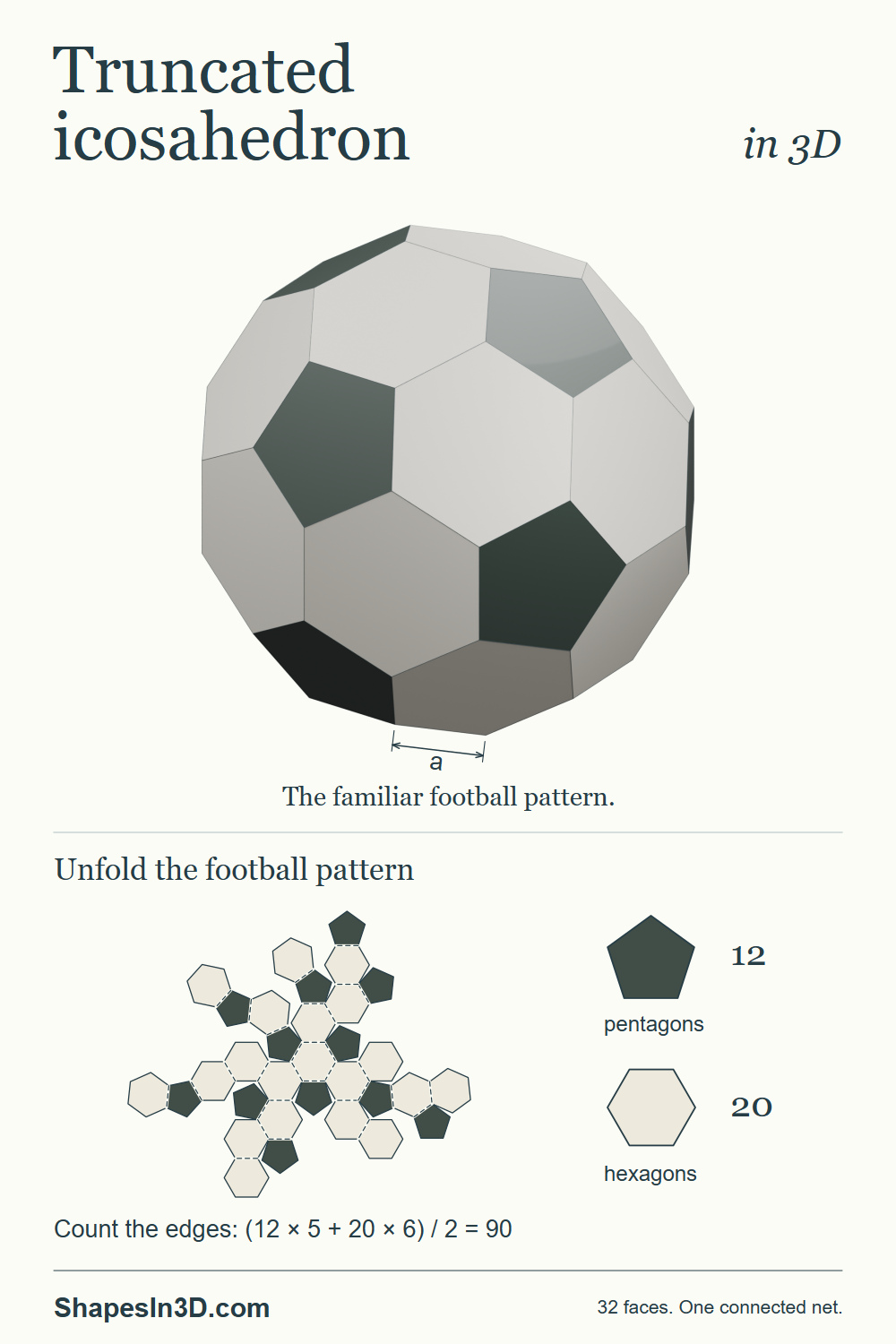
- 12 pentagons
- Five equal edges around each pentagon.
- 20 hexagons
- Six equal edges around each hexagon.
- (12 × 5 + 20 × 6) / 2 = 90
- Each outside edge belongs to two faces.